
How to Search San Mateo County Court Records
The Superior Court runs two free search tools. MIDX, the San Mateo County Superior Court Records Index, is at web.sanmateocourt.org/midx. It is an index. It points you to a case number but it does not show case papers. The Odyssey Public Portal is the deeper tool. It lists the register of actions and, where the law allows, the case documents. The court explains the split on its Odyssey portals page.
The image below leads to the court's main online entry page, which links to case search, courtroom lists, tentative rulings, and self-help. Visit sanmateo.courts.ca.gov to see the live site.
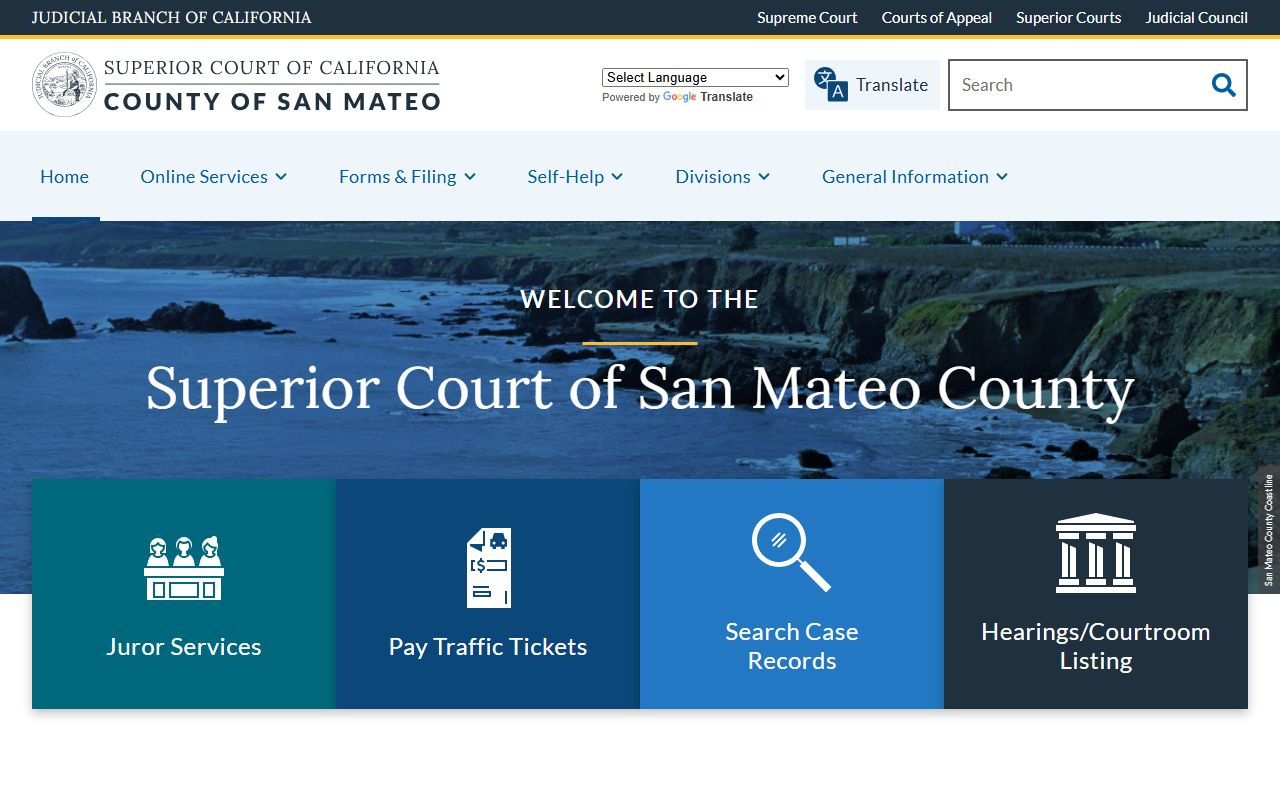
The home page groups case search, location info, jury duty, and self-help in plain blocks. Most San Mateo County court records searches start here and then move to MIDX or Odyssey for the actual lookup.
Before you start, grab a case number if you have one. If you do not, write down the full name, a date range, and the case type (civil, criminal, family law, probate, small claims, or traffic). The court does not run searches for you. Records Management says staff will not research files for the public. So the best path is short: use MIDX first to find a case number, then move to Odyssey for the docket.
Step-by-step search
- Open MIDX at web.sanmateocourt.org/midx and pick the right tab: Case Number, Person, Business, or Filing Date.
- For a case number, type at least five alpha-numeric characters. Old converted numbers begin with letters such as CIV, CLJ, FAM, PRO, SCS, SCC, SCN, NM, NF, SC, SF, or SM. Native Odyssey numbers start with a two-digit year, e.g., 16CIV00123.
- For a person, type at least two characters in both First Name and Last Name. Add an asterisk after a partial term for a wildcard search (Smit*).
- For a business, type at least three characters and use the asterisk if the company name has odd punctuation.
- For a filing-date search, keep the date range to five calendar days or fewer; MIDX rejects longer windows.
- Switch to the Odyssey Public Portal with the case number to see the register of actions and any non-sealed documents that are allowed online.
- If a case file is needed in paper form, request a copy by mail through Records Management or visit the counter in person.
Note: MIDX is index-only and does not link to Odyssey; copy the case number by hand or paste it across the two tools.
The San Mateo County Judicial System
California has a unified trial court in every county. Since the 1998 unification under Proposition 220, there is no Municipal Court, no Justice Court, and no County Court at Law in California. Every trial-level matter, from a $100 small claims dispute to a felony jury trial, runs through one court: the Superior Court of California, County of San Mateo. Appeals go to the California Court of Appeal, First Appellate District, in San Francisco. The Supreme Court of California sits above that.
The court is run by a presiding judge and staffed by a Court Executive Officer who serves as Clerk of the Superior Court. The bench has trial judges, commissioners, and pro tem judges. The court posts its directory of judges with names, departments, and assignments. The directory image below shows how the court lists its judges by department and case area.
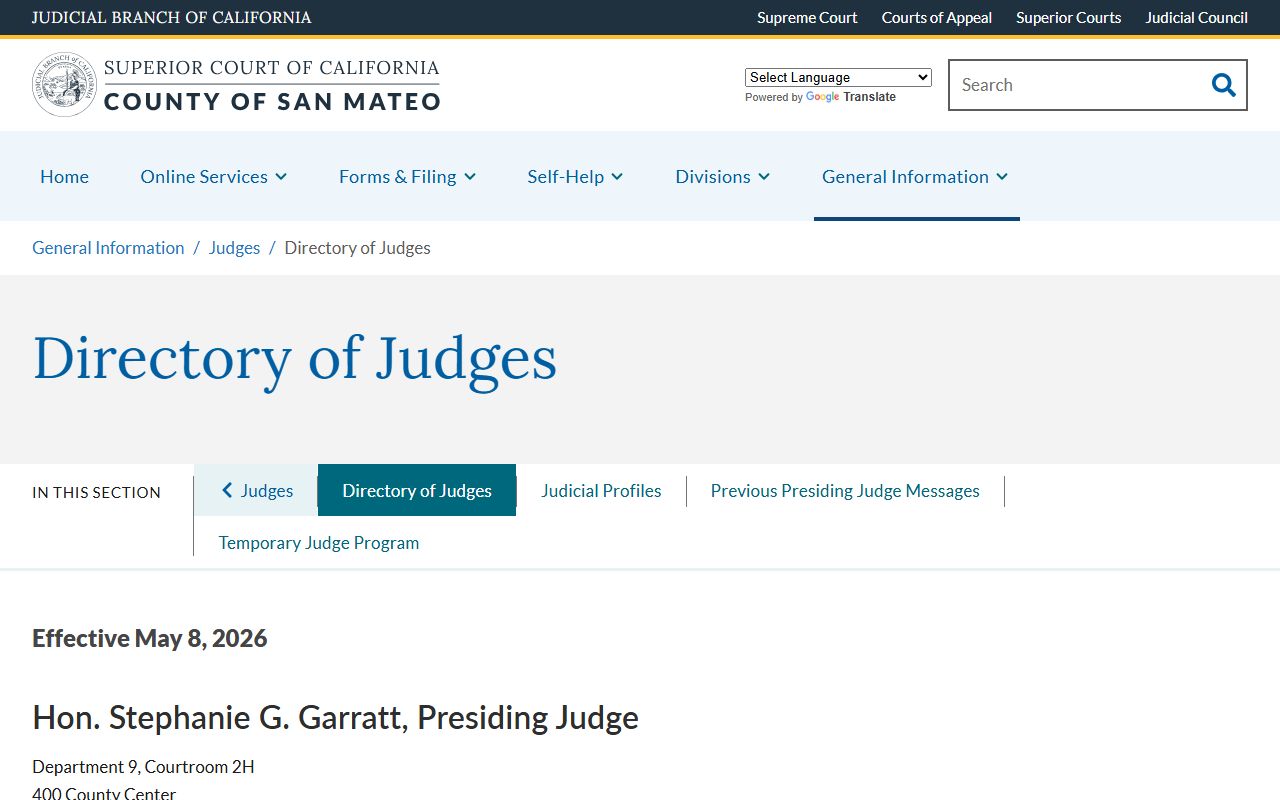
Each judge handles a department, sometimes called a courtroom. When a case shows a department number in a docket, that points to a specific judge or calendar.
Case flow: Superior Court (Limited / Unlimited) › California Court of Appeal, First Appellate District › Supreme Court of California. Federal cases for the county go to the U.S. District Court for the Northern District of California, not the Superior Court.
| Court | Jurisdiction | Case Types |
|---|---|---|
| Superior Court of California, County of San Mateo | Trial court; full county | Civil, criminal, family, probate, small claims, traffic, juvenile, mental health |
| California Court of Appeal, First District | Intermediate appellate | Appeals from San Mateo Superior Court |
| Supreme Court of California | Highest state court | Discretionary review, capital cases, state bar matters |
| U.S. District Court, Northern District of California | Federal trial court | Federal civil, federal crimes, civil rights, federal-question cases |
San Mateo County Courthouses
The Superior Court runs four branch locations. The main hub for public records is the Hall of Justice and Records in Redwood City, where Records Management, the Civil and Probate Divisions, and the Criminal Division all sit. The Northern Branch in South San Francisco is the home of the Traffic Division. The Central Branch in San Mateo handles small claims and unlawful detainer matters. The Juvenile Branch handles dependency and delinquency cases on Paul Scannell Drive. The image below leads to the court's official locations page.
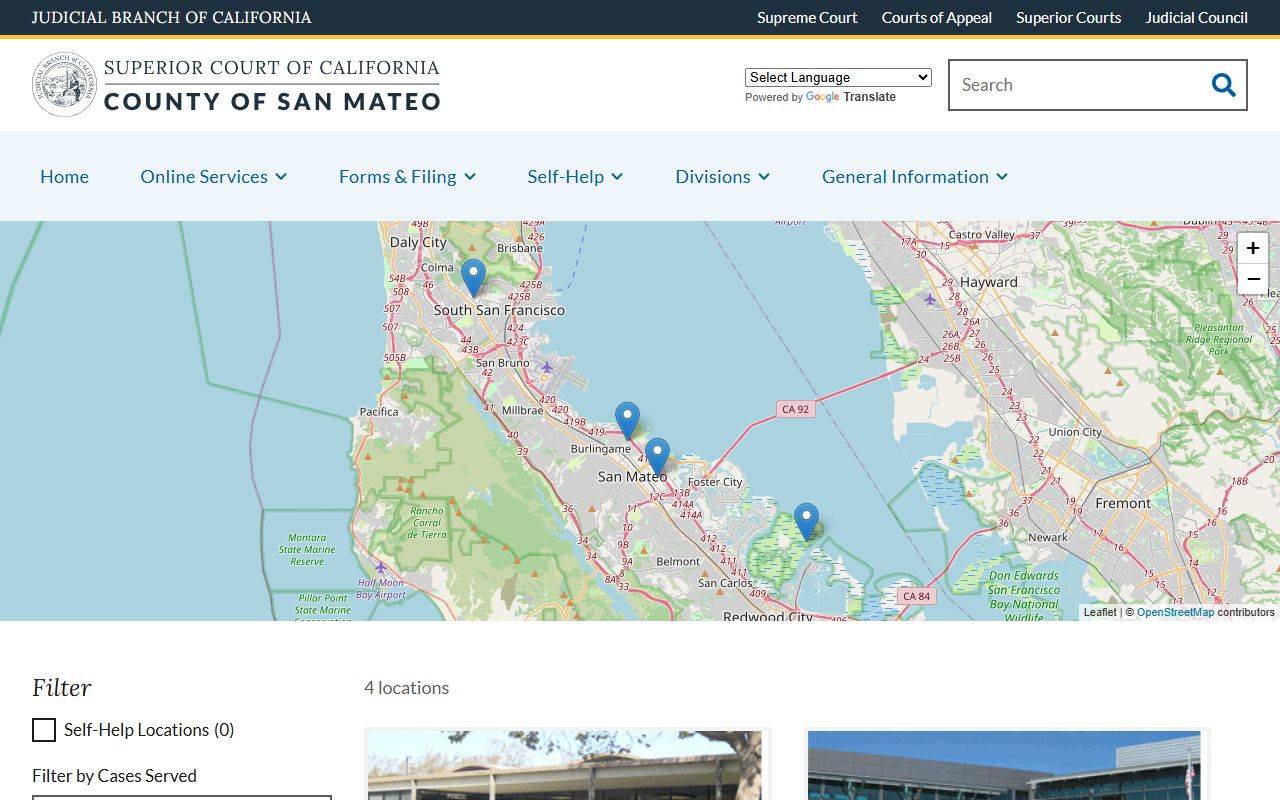
All four branches use the same main phone line, (650) 261-5100, and each branch routes calls by division through an option menu.
Hall of Justice and Records (Southern Branch)
400 County Center
Redwood City, CA 94063
(650) 261-5100
Northern Branch
1050 Mission Road
South San Francisco, CA 94080
(650) 261-5100
Juvenile Branch
222 Paul Scannell Drive
San Mateo, CA 94402
(650) 261-5100 option 8
Types of Court Records Available in San Mateo County
The Superior Court keeps every kind of trial-court file in one system. Each case type has its own number prefix, its own forms, and its own access rules. Civil unlimited cases run from CIV; civil limited from CLJ; family law from FAM; probate from PRO; small claims from SCS, SCC, or SCN; and criminal from NM, NF, SC, SF, or SM. After June 15, 2016, native Odyssey numbers begin with a two-digit year, then a three-letter type prefix.
Not every case type appears the same way online. The Odyssey Public Portal shows the register of actions for most categories but blocks documents for family law at this time. Juvenile, adoption, and mental health cases stay off the public portal under California Rules of Court rule 2.503 and Welfare and Institutions Code section 827.
- Civil records include complaints, motions, orders, judgments, dismissals, and writs.
- Criminal records cover charging papers, arraignment minutes, plea entries, bail orders, and sentencing.
- Family law records include divorce, custody, support, and protective orders; documents are not posted online.
- Probate records cover wills, estates, trusts, guardianships, and conservatorships.
- Traffic records are kept by the Traffic Division at the Northern Branch and viewable through Odyssey.
- Court dockets show hearings, filings, and orders in date order.
- Small claims records are filed at the Central Branch and indexed in MIDX.
What San Mateo County Court Records Show
A case file holds a record of every step in the case. The public docket shows the date, the filing party, and a short title for each entry. The clerk's minute orders summarize what happened in court each day. Some fields are open to anyone; others are redacted under California Rules of Court rule 2.503 and rules 2.550 through 2.551. The table below maps the common visible fields to what they actually mean in a San Mateo County court record.
| Field | What It Shows |
|---|---|
| Case Number | Court file ID with type prefix (CIV, FAM, PRO, NM, etc.) or year-prefixed Odyssey number after June 15, 2016 |
| Filing Date | Date the complaint, petition, or citation was filed |
| Parties | Plaintiff and defendant, petitioner and respondent, or People vs. defendant |
| Charges / Cause | Statute and short title for each charge or claim |
| Department | Courtroom number tied to the assigned judge or calendar |
| Register of Actions | Docket entries in date order: filings, hearings, orders, minutes |
| Disposition | Final outcome: judgment, dismissal, plea, acquittal, sentencing |
| Financials | Filing fees, bail, fines, restitution, fee waiver status |
The court redacts dates of birth, Social Security numbers, driver license numbers, financial account numbers, and medical or psychiatric data. Victim addresses and minor names are also held back. So a record may have empty fields where private items used to sit.
Public Access Laws for San Mateo County Court Records
Court case records are open to the public under a long line of California rules and case law, but the rules carve out clear limits. The California Public Records Act covers state and local agency records, not court case files. Court files are handled under the California Rules of Court and the trial-court retention statute. The Sheriff, the District Attorney, and the County Clerk-Recorder all run their public records under the CPRA. The Superior Court runs administrative records under California Rules of Court rule 10.500.
San Mateo posts a separate email, administrativerecords@sanmateocourt.org, for any court administrative-record request. Case file copy requests go to Records Management, not that email.
Key Statutes:
California Government Code § 7920.000. Names Division 10 as the California Public Records Act, the baseline law for state and local agency records.
California Government Code § 7922.000. Sets the general balancing test that lets an agency withhold records when nondisclosure clearly outweighs disclosure.
California Government Code § 68150. Gives the Judicial Council authority over trial court records and retention rules.
California Welfare and Institutions Code § 827. Locks juvenile case files; only listed people or court orders unlock access.
California Penal Code § 851.91. Lets a person petition to seal an arrest record when the arrest did not lead to a conviction.
Image below: the official short-title statute page for the California Public Records Act, hosted by California Legislative Information.
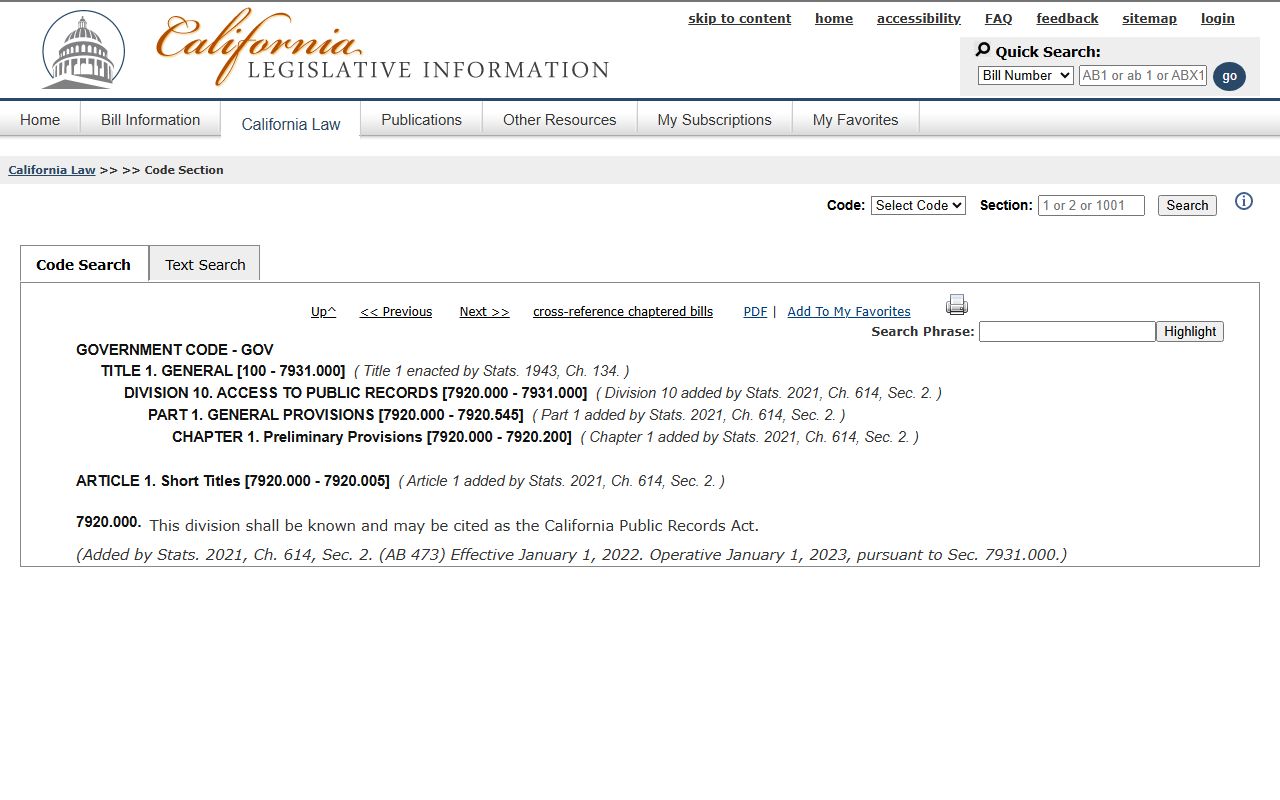
Use the statute page to confirm the exact text, since the act was recodified by AB 473 with an operative date of January 1, 2023.
Records That Are Restricted or Confidential
Not every court file is open. The court holds back juvenile cases, adoption files, mental health matters, and certain sealed records. Juvenile delinquency and dependency files are closed under Welfare and Institutions Code section 827. Adoption files are closed under Family Code section 9200. Mental health cases are not posted online under California Rules of Court rule 2.503. Family law documents are not displayed on the public Odyssey portal at this time, even when the index shows the case exists. Sealed records sit under rules 2.550 and 2.551 and need a court order to view.
Active investigation records held by the Sheriff or the District Attorney can be withheld under Government Code § 7923.610. Victim and witness addresses are held back even in otherwise public files. Trade secrets in civil cases may be sealed where the law allows.
To view a closed file, a person normally must be a party, an attorney of record, or someone with a statutory right. Anyone else needs a court order. The first step is to file a petition with the right division and serve all interested parties.
Specialty Courts in San Mateo County
The Superior Court runs a Collaborative Court track for cases that need treatment plans rather than standard sentencing. The court's Veterans Treatment Court serves current and former U.S. military members in the criminal system. The goal is to link veterans to mental health care, substance abuse counseling, health care, job training, and housing. A Deputy Probation Officer supervises each veteran in the program, and progress reviews come back to court for regular hearings.
Image below: the official Veterans Treatment Court page, which lists how a case is referred and what the program asks of each participant.
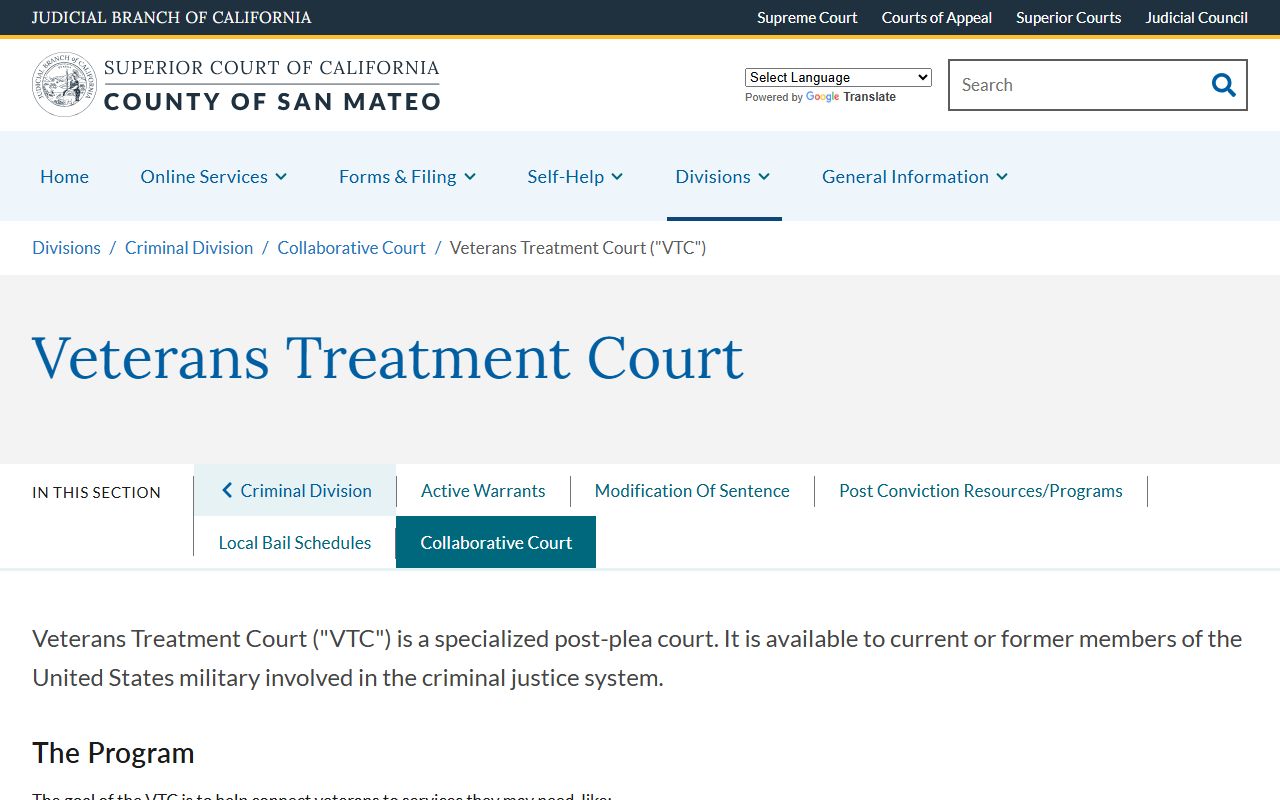
The Collaborative Court umbrella also covers CARE Court, the state's Community Assistance, Recovery, and Empowerment court for people with schizophrenia spectrum or other psychotic disorders. CARE Court is civil and treatment-focused; the county Behavioral Health and Recovery Services team works with the court on each plan.
The Civil Grand Jury is a 19-citizen body created by the California Constitution. It is not a treatment court, but it is a judicial body of the Superior Court. The Civil Grand Jury investigates county and city offices, takes complaints, and issues public reports. If indictments are needed, a separate criminal grand jury is called.
San Mateo County Sheriff and Jail
The San Mateo County Sheriff's Office runs the county jails and serves court process. Sheriff Kenneth Binder was sworn in as the 27th Sheriff on November 12, 2025. He took office after the Board of Supervisors removed the prior sheriff on October 14, 2025 under the local Measure A and Government Code section 24105. The Sheriff biography page sits at smcsheriff.com/sheriff-kenneth-binder.
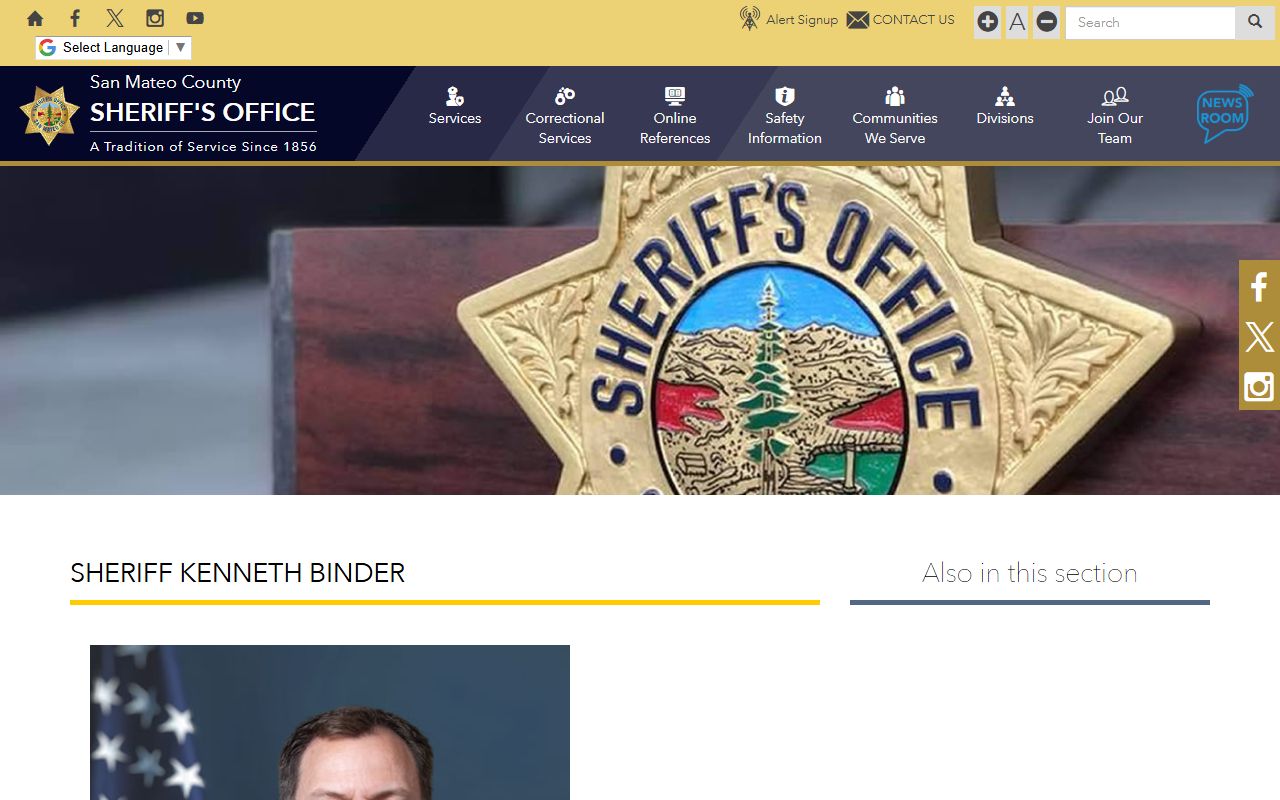
The Corrections Division runs two facilities. Maguire Correctional Facility sits at 300 Bradford Street, Redwood City. Maple Street Correctional Center sits at 1300 Maple Street, Redwood City. Both house adult inmates and use Keefe Commissary for in-custody packages.
The Sheriff Inmate Locator at smc-inmatelocator.org is the public search for current bookings. It shows facility, charges, bail, next court date, and projected release date. For full roster details and field lists, see the San Mateo County inmate records page. For active court warrants, see warrant records. For release alerts, see the released inmates page. Population data for both jails sits on the jail population page.
Note: the locator warns that some bookings may not appear because of law enforcement disclosure exemptions, so call the local agency if a name is missing.
Marriage, Divorce, and Probate Records
San Mateo County splits these records between two offices. Marriage licenses and marriage certificates are issued by the San Mateo County Clerk-Recorder at 555 County Center, on the first floor. Divorce records are family law case files kept by the Superior Court at 400 County Center. Probate cases sit with the Superior Court's Probate Division, also at 400 County Center, first floor. For full guides, see marriage and divorce records and probate records.
A few legal terms keep coming up across probate and family law records. The list below covers the ones most readers run into first.
- Testator
- The person who made a will.
- Executor
- The person named in a will to settle the estate.
- Intestate
- Dying without a will; the estate passes under California intestate succession rules.
- Conservator
- An adult appointed by the Probate Division to handle the care or money of another adult who cannot do so.
- Petitioner
- The party who files the petition, common in family law, probate, and some civil cases.
- Respondent
- The party who responds to a petition.
Marriage licenses cost $79 for a public license and $80 for a confidential license. A certified marriage certificate copy from the Clerk-Recorder is $19. The court charges $15 for a certified copy of a marriage or domestic partnership dissolution. See the fee section below for a fuller list.
San Mateo County Court Records Fees
The Superior Court charges a small per-page fee for copies, plus separate fees for certified copies, exemplification, file searches over 10 minutes, and off-site file retrieval. The fees come from the court's official records fee list at Records Management. Pay by check made out to Superior Court with a "not to exceed" line; the clerk fills in the exact amount.
| Item | Amount |
|---|---|
| Copy of any record, proceeding, or paper on file | $0.50 per side |
| Certified copy of marriage or domestic partnership dissolution record | $15.00 |
| Certifying a copy of any paper, record, or proceeding on file | $40.00 |
| Exemplification | $50.00 |
| Comparing copy with original | $1.00 per side |
| Records search longer than 10 minutes | $15.00 |
| Retrieval of file stored off-site | $10.00 |
Mail a copy request to: San Mateo Superior Court, Records Management, 400 County Center, 1st Floor Room A, Redwood City, CA 94063. Include the case number, the names of the parties, the filing date or document description, a self-addressed stamped envelope, and the blank check. The court replies within 30 days.
How to Read San Mateo County Court Records
Court records use a lot of short codes. A charge of "PC 245(a)(1)" means California Penal Code section 245, subdivision (a)(1), assault with a deadly weapon. A code such as "VC 22350" is the basic speed law in the Vehicle Code. A "FTA" entry in a docket flags a failure to appear. A "BW" entry flags a bench warrant. A "ROA" is the register of actions, the full chronological docket.
Read charges and convictions as separate items. A charge filed by the DA is not a finding of guilt. A disposition shows what the court did with the charge: guilty plea, no contest, jury verdict, dismissal, acquittal, or diversion. A guilty disposition followed by a Penal Code section 1203.4 dismissal still leaves the case file in place; the disposition is updated but the file is not erased.
Sentencing terms show probation length, jail or prison time, fines, restitution, and any program orders. A note that says "OR" means released on own recognizance. A note that says "PRCS" means Post-Release Community Supervision, a county-supervised release after some state prison terms.
Accuracy and Record Limitations
Court records update on a delay. A clerk types up minute orders after the hearing ends. Pleadings filed by mail take time to scan and post. Old converted cases from before June 15, 2016 may show partial data because the old database fields did not map one-to-one into Odyssey. So a case that looks short online may have more papers in the file room.
Note: Confirm key dates and outcomes with the originating court division before relying on any online listing for a legal, employment, or housing decision.
To correct an error, call the division that handles the case. Civil, family, probate, and small claims errors go to Records Management or the matching division clerk. Criminal errors go to the Criminal Division on the fourth floor of the Hall of Justice. Traffic errors go to the Traffic Division at the Northern Branch.
History of San Mateo County Courts
San Mateo County was carved out of San Francisco and Santa Cruz Counties in 1856. The first courthouse went up in 1858 on land donated by Simon Mezes. The 1910 courthouse in Redwood City survived the 1989 Loma Prieta earthquake and now houses the San Mateo County History Museum. The active court complex is the Hall of Justice and Records, a few blocks away on County Center.
California unified all trial courts in 1998 under Proposition 220. Before that, San Mateo had separate Municipal Courts for limited civil and misdemeanor cases. Those courts no longer exist. Every trial-level matter now lives inside the Superior Court. The court moved to the Odyssey case-management system on June 15, 2016; native case numbers since then start with the two-digit year. The MIDX records index went live as a free public lookup. The Civil Grand Jury, a tradition that runs from English and early American practice, still investigates local government every year.
Recent governance history matters for jail and records pages. In 2025, county voters passed Measure A. The Board of Supervisors removed the elected sheriff in October 2025 and appointed Kenneth Binder in November 2025. Sheriff's Office policy materials were updated under Sheriff Binder in 2026.
Self-Help and Legal Aid Resources
The Superior Court runs a Self-Help Center and Family Law Facilitator. The center helps people who do not have a lawyer with divorce, custody, child support, restraining orders, guardianship, conservatorship, landlord-tenant issues, and small claims. The court's self-help page offers a LiveChat box during posted hours.
Image below: the court's self-help and legal resources page, which lists the Bay Area Legal Aid DVRO clinic, the Small Claims Advisor, and the Landlord/Tenant Clinic.
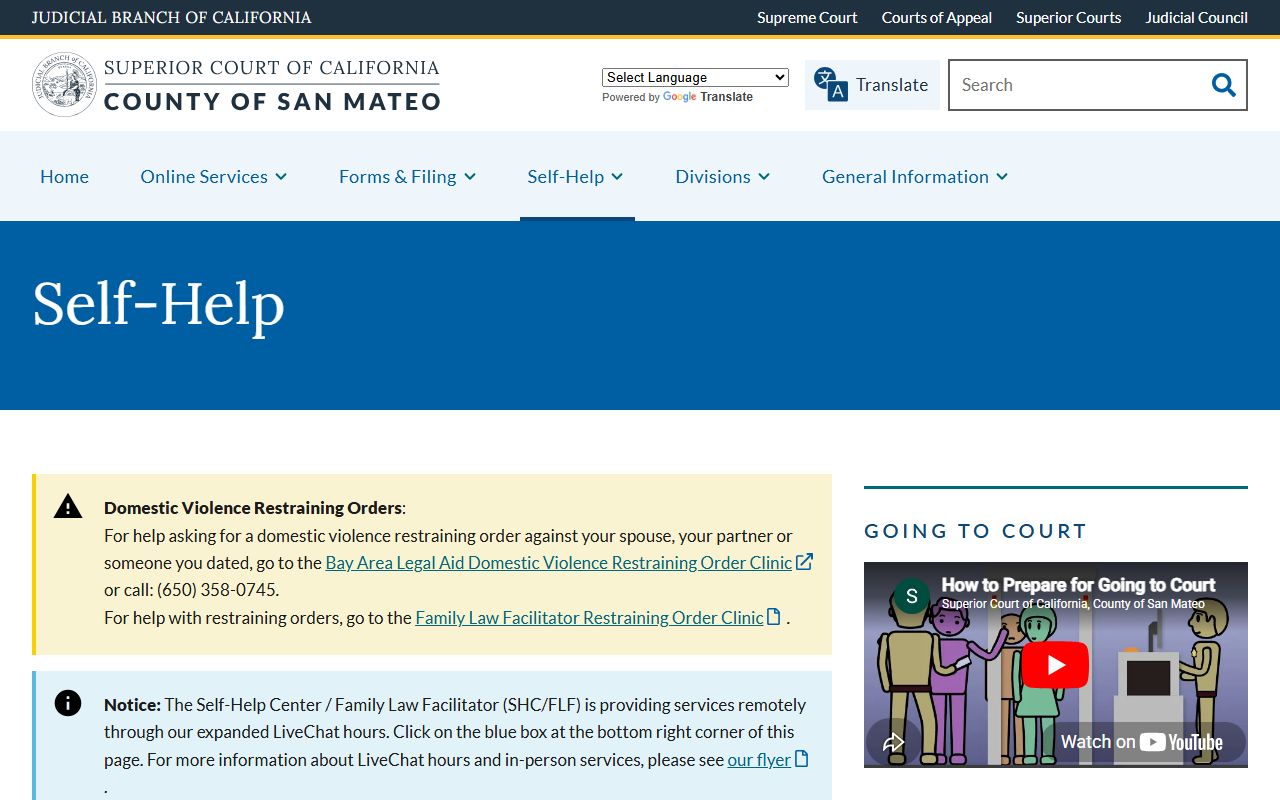
For criminal cases, indigent defense is provided by the San Mateo County Private Defender Program at pdpsmcba.org, not by a county Public Defender's Office. PDP is a managed assigned counsel program. The court appoints PDP and PDP assigns a panel attorney. Call PDP at (650) 298-4000.
Other local resources include Bay Area Legal Aid at 1048 El Camino Real, Suite A, Redwood City, (650) 358-0745, for family law and housing help; the Legal Aid Society of San Mateo County at 330 Twin Dolphin Drive, Suite 123, Redwood City, (650) 517-8936; and the DA Victim Services unit at smcgov.org/da/victim-services for crime victim support.
Frequently Asked Questions
How do I search San Mateo County court records online?
Start with MIDX at web.sanmateocourt.org/midx to find a case number or confirm a non-confidential case exists. Search by case number, person name, business name, or filing date. Then open the Odyssey Public Portal for the register of actions and any non-sealed documents the court allows online. Family law documents are not posted on the public portal.
What is the difference between MIDX and Odyssey?
MIDX is an index. It tells you the case exists and gives you the case number. Odyssey is the case-management system. It shows the register of actions, hearing dates, and, for some case types, the documents. The court runs separate Odyssey portals for the public, for attorneys, and for self-represented litigants. Public access does not need a login.
Where do I get a marriage license?
Go to the County Clerk Division at 555 County Center, 1st Floor, Redwood City. Marriage license hours are 8:00 a.m. to 4:30 p.m., Monday to Friday. Both parties must show up with valid government-issued photo ID. Call the appointment line at (650) 599-1713. Walk-ins are accepted. A public marriage license costs $79.
How do I look up a San Mateo County inmate?
Use the Sheriff Inmate Locator at smc-inmatelocator.org. Enter both first and last name and click Find Inmate. Use the phonetic checkbox when you are not sure of the spelling. To verify by phone, call Maguire Correctional Facility at (650) 363-4000 extension 6070 with the inmate's name and correct date of birth. See the inmate records page for more.
Who is the current Sheriff of San Mateo County?
Sheriff Kenneth Binder. He was sworn in as the 27th Sheriff on November 12, 2025 after the Board of Supervisors removed the prior sheriff on October 14, 2025. The official Sheriff biography is at smcsheriff.com/sheriff-kenneth-binder.
How do I find an active warrant?
Start with the Superior Court Criminal Division's Active Warrants page. The court does not run a public warrant roster, so search the underlying case in MIDX or Odyssey. If a person has been booked, the Sheriff Inmate Locator shows facility, charges, bail, and next court date. See the warrant records page for details.
Where do I get divorce records?
Divorce records are Superior Court family law case files, not vital records. Request copies from Records Management at 400 County Center, 1st Floor Room A, Redwood City. The court charges $15 for a certified copy of a dissolution record. Family law documents are not posted on the public portal, so you may need to mail a request or visit in person.
More on the San Mateo County Court Records FAQ page, plus full guides at court records, court dockets, public records, Clerk of the Superior Court, and the main Superior Court page.