
What San Mateo County Probate Covers
Probate in San Mateo County is a single track inside the Superior Court. California unified its trial courts in 1998, so there is no stand-alone probate court here. The Probate Division handles every type of estate, trust, guardianship, and conservatorship that runs through the county. Cases are filed at the Hall of Justice and Records at 400 County Center, Redwood City. The division also runs Probate Court Investigators, who report on proposed conservatees and minor wards. Most filings end up in the county index, and the clerk keeps the paper file at Records Management on the 1st Floor.
The work covers more than wills. Decedent estate cases drive much of the docket, but the division also hears trust petitions, accountings, claims against estates, and final distribution orders. Guardianship of minors and conservatorship of adults run through the same set of judges. Mental health holds and some special trust matters also land here. Many users come in to track a parent's estate, but just as many come in to set up a guardianship for a niece or nephew, or to start a conservatorship for an aging relative. The case set is wide.
Note: A small estate may not need full probate at all if the heir uses the affidavit procedure set by state law.
San Mateo County Probate Terms Defined
Probate uses old legal terms that trip up first-time filers. The list below sets out the words used in San Mateo County probate records and on court forms. Knowing these helps when reading a register of actions or a petition. Each term has a clean, plain meaning that matches how the clerk and judges use it on the record.
- Testator
- The person who wrote and signed the will. A female may also be called a testatrix in older filings.
- Executor
- The person named in the will to carry out its terms, pay claims, and pass property to heirs.
- Administrator
- The person the court names to run an estate when no will exists or when the named executor cannot serve.
- Intestate
- Dying with no valid will. State law then sets who gets the estate.
- Heir
- A person who takes from an intestate estate by blood, marriage, or adoption.
- Beneficiary
- A person or group named in a will or trust to receive money or property.
- Guardianship
- A court order placing a minor under the care of an adult who is not the child's parent.
- Conservatorship
- A court order giving one adult the legal power to manage the person, estate, or both, of another adult who cannot do so alone.
How to Search San Mateo County Probate Records
Two portals carry the bulk of San Mateo County probate records online. The first is MIDX, the San Mateo County Superior Court Records Index. MIDX lists appeals, civil, criminal, family law, probate, and small claims cases. It is an index only, so it tells the user a case exists and gives a case number, but it does not link straight into the document portal. The second tool is the Odyssey Public Portal, which holds the register of actions and, for non-confidential cases, some document images.
Probate case numbers in San Mateo follow a clear pattern. Converted cases start with PRO. Native cases use a year prefix with PRO, such as 16PRO00123. A user who knows the case number can run it through both tools and see filings line up. A user who only has a name can run a person search on MIDX with the first two letters or more, then move to Odyssey for the register of actions. The court warns that some probate documents stay behind the counter and are not posted online at all. For those, the user must visit Records Management or send a mail request.
Below is the basic walk-through for searching San Mateo County probate records online or in person.
- Open MIDX and pick Person Search. Type the decedent, ward, or conservatee's first and last name with at least two letters. Use the asterisk as a wildcard if the spelling is unsure.
- Note the case number and the case type (PRO). Confirm filing date and court branch on the result line.
- Switch to the Odyssey Public Portal. Run Smart Search by case number to pull the full register of actions and any public document images.
- If the case is not online or shows as restricted, plan a visit to Records Management at 400 County Center, 1st Floor, Room A. Public file viewing runs Monday through Friday, 8:30 a.m. to 1:00 p.m.
- Bring a check or cash for copies. The clerk fills five files at a time. After return, the user may ask for five more.
- For copies by mail, send case number, parties, filing date or document name, a self-addressed stamped envelope, and a blank check made to Superior Court with a not-to-exceed amount on the memo line.
Note: A no-result search does not always mean no case exists, since sealed and confidential probate files do not appear in the public index.
Statutes That Drive San Mateo County Probate
State law sets the rules every San Mateo County probate filing must follow. The petition to start a decedent estate is filed under California Probate Code section 8000, which spells out who can ask the court to open the estate and appoint a personal representative. The image below shows that section as posted on the official state legislature site.
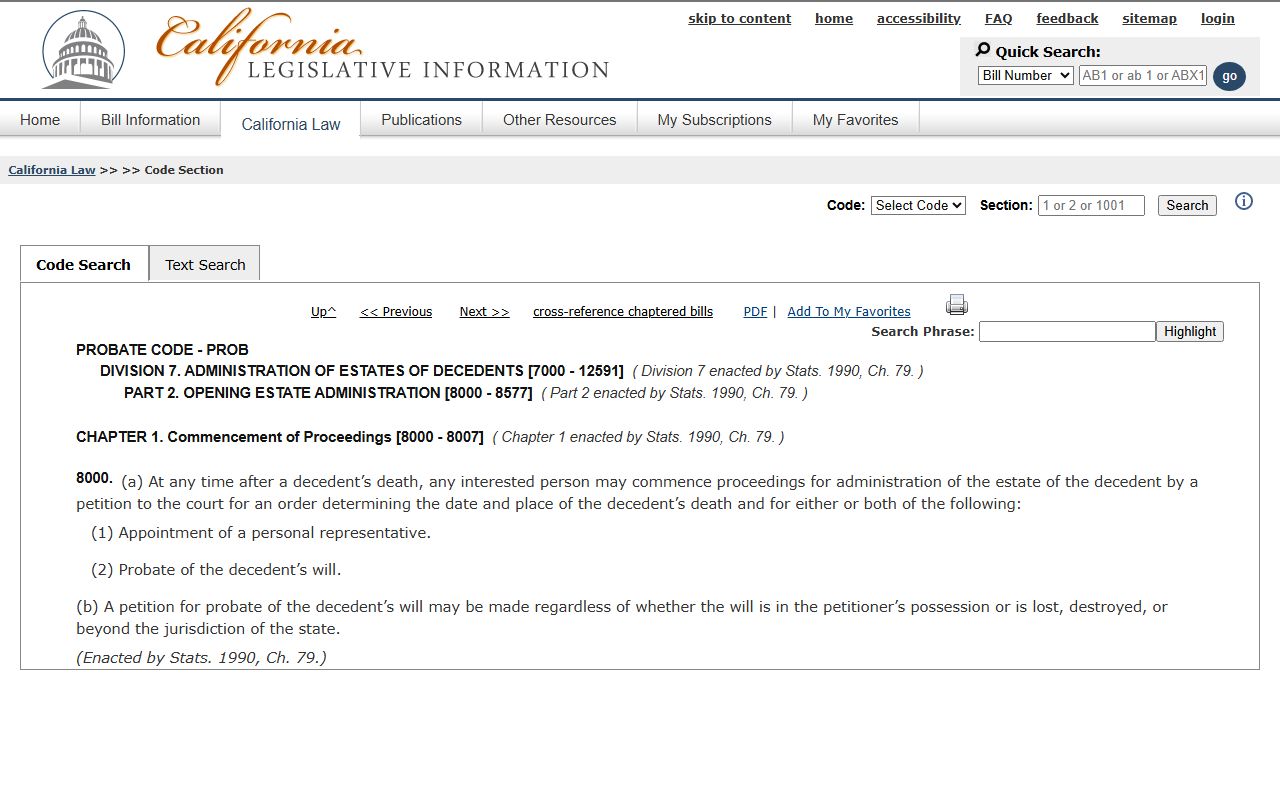
That statute is the anchor for any San Mateo County probate filing that involves a will. It controls venue, the form of the petition, and notice to heirs. The Probate Division clerk uses it to check that every new case meets the basic legal test before it gets a hearing date.
Small estates run on a different track. The small-estate affidavit under section 13100 lets an heir collect personal property without a full probate case if the total value sits below the state threshold and the waiting period has passed.
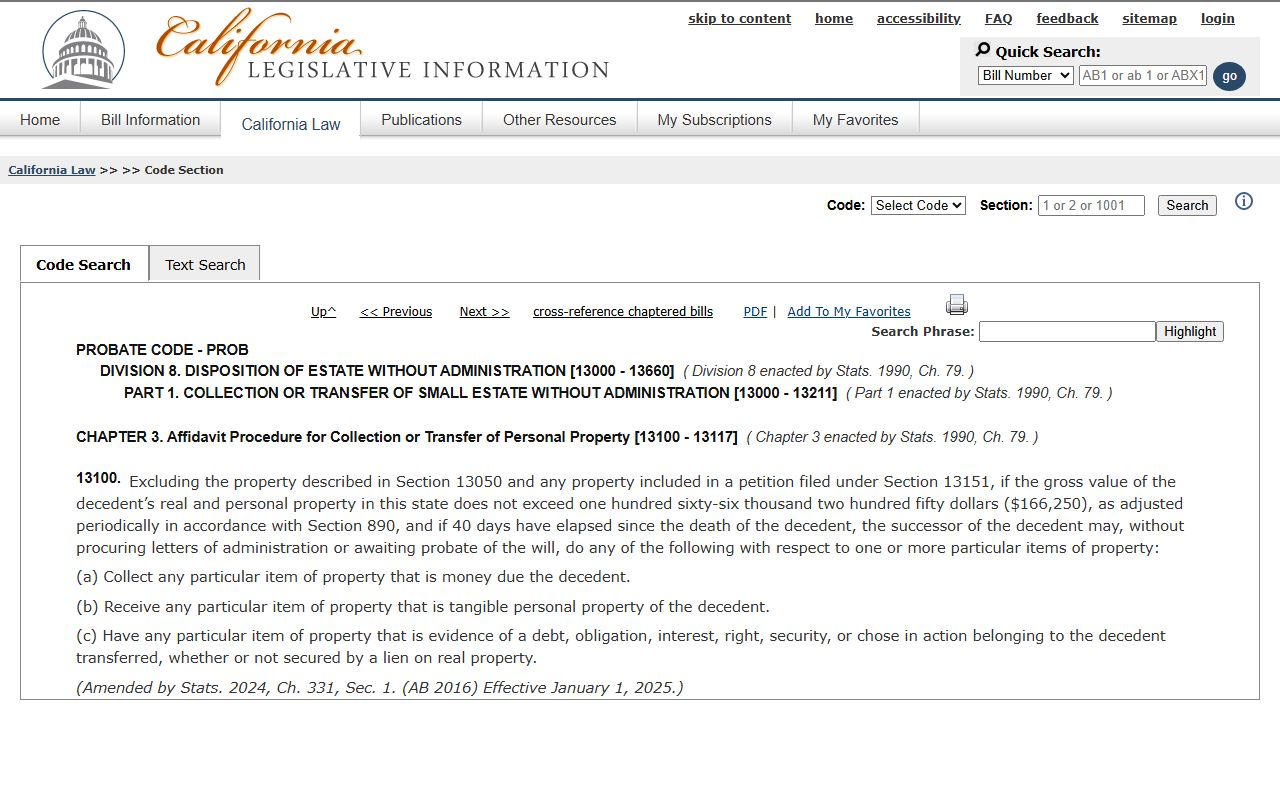
The state updates the dollar threshold every few years, so users should check the live statute before signing an affidavit. The form is presented to a bank, broker, or transfer agent, not filed with the San Mateo court.
San Mateo County Probate Division Contact
The Probate Division shares the main courthouse with civil, family, and records management. All hearings, filings, and counter visits happen at 400 County Center in Redwood City. Probate Court Investigators sit on the 8th floor of the same building and have their own phone line.
Probate Division, Superior Court
Hall of Justice and Records
400 County Center, 1st Floor
Redwood City, CA 94063
(650) 261-5100
Phone hours: Mon-Fri 8:30 a.m. to 1:00 p.m.
Probate Court Investigators
400 County Center, 8th Floor
Redwood City, CA 94063
(650) 261-5068
Mon-Fri 8:30 a.m. to 1:00 p.m.
The official Probate Division page lists hearing calendars, judicial assignments, and forms. The screenshot below shows that landing page as it appeared during research.
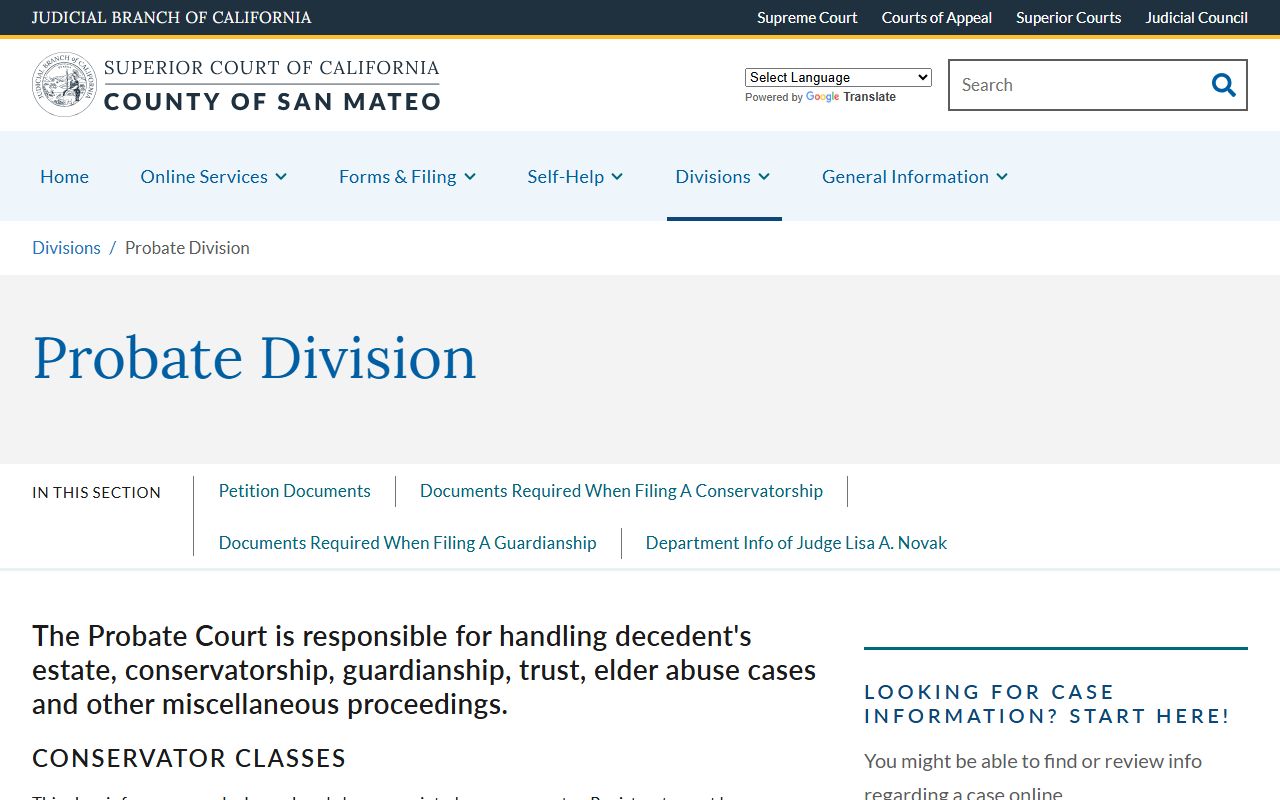
The page links out to the self-help center, the Family Law Facilitator, and the statewide California Courts probate guide. Users who plan to file should bookmark it.
San Mateo County Probate Filing Fees
Probate filing fees are set by state law. Government Code section 70620 and the linked statute set lay out the base amounts that every California Superior Court must charge, and the San Mateo Superior Court fee schedule sets the local copy and search rates. The table below shows the figures most often paid at the Probate Division counter and at Records Management. Always check the live fee schedule before mailing a check, since the state adjusts fees from time to time.
| Item | Amount |
|---|---|
| Plain copy of any record on file, per side | $0.50 |
| Certifying a copy of any paper, record, or proceeding on file | $40.00 |
| Exemplification (triple-seal) | $50.00 |
| Search of court files longer than 10 minutes | $15.00 |
| Retrieval of file stored off-site | $10.00 |
| Comparing copy with original, per side | $1.00 |
The court does not publish a single flat fee for opening a probate estate. The base filing fee is set by state law, and added charges may apply for first-paper appearances by each party, a will deposit, or special letters. The clerk will quote the current amount when a petition is brought to the counter. Fee waivers are allowed for low-income filers. Form FW-001 starts that request and is reviewed by the same probate clerk who logs the petition.
Note: Mail copy requests use a blank check made to Superior Court with a not-to-exceed amount on the memo line, since the clerk fills in the exact charge.
How to Open a Probate Case in San Mateo County
Opening a probate case is the most common reason a member of the public walks into the Probate Division. The steps below match the script the court self-help center gives and the workflow set out in state law. Even a small filing should be planned step by step, since a missed notice or bond can stall the case for weeks.
- Decide whether full probate is needed. If the estate sits below the state small-estate ceiling, the heir may use a section 13100 affidavit and skip court.
- Gather the will (if any), the death certificate, a list of heirs, and a draft inventory of the estate's assets.
- Fill out the Judicial Council probate petition and any local cover sheet. Self-help forms are free at the court self-help center and online.
- File the petition at the Probate Division counter at 400 County Center. Pay the filing fee or file a fee waiver.
- Publish notice in a local paper and mail notice to heirs and named beneficiaries.
- Appear at the hearing for appointment. The judge signs the order and issues letters testamentary or letters of administration.
- Manage the estate. File the inventory and appraisal, handle creditor claims, pay taxes and bills.
- Account to the court and ask for final distribution. The judge signs the order, the property passes to the heirs, and the case closes.
The court self-help page also lists guardianship and conservatorship walk-throughs, which use a similar but shorter set of steps. The image below shows the official guardianship self-help entry point.
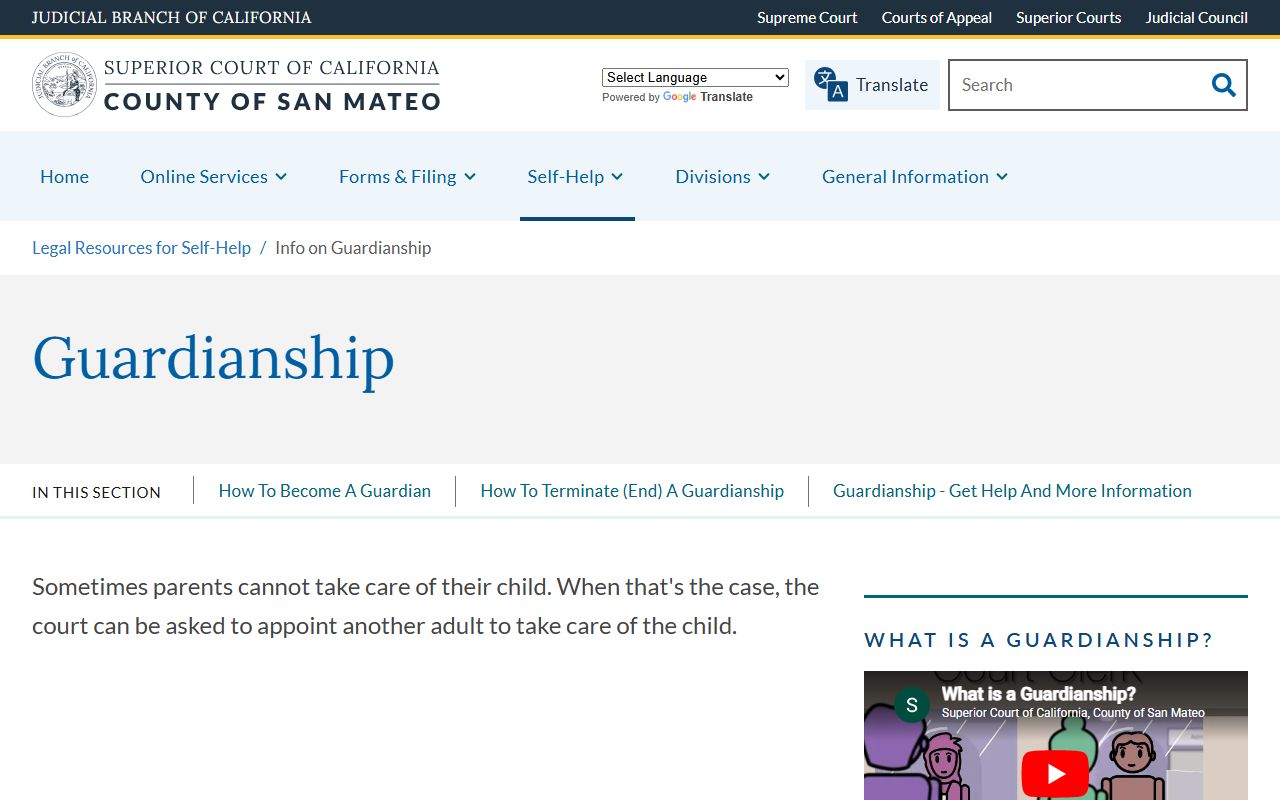
That self-help page links to the local forms list and walks the user through the next steps for naming a guardian for a minor child.
What San Mateo County Probate Records Show
A full San Mateo County probate file is a stack of papers built up over months or years. The register of actions is the spine of the case. It lists every paper filed, every hearing held, and every order signed. The rest of the file is the underlying documents, from the first petition to the last accounting. Some pieces are public from the day they hit the counter; others may be shielded by court order or by state law.
Common items in a decedent estate file include the original will, the petition for probate, proof of subscribing witness, the order appointing personal representative, letters testamentary or letters of administration, notice to creditors, the inventory and appraisal, accountings, and the final order of distribution. Trust petitions add the trust instrument and any modifications. Guardianship and conservatorship files add the investigator's report, medical declarations, and care plans. Some of those items stay sealed.
A user who pulls a file at Records Management should bring a notepad and budget time to read it on site. The five-file viewing limit applies to probate just like to civil. After return, the user may ask for five more. One same-day copy of each file is allowed unless copies are prepaid. Off-site files cost $10 each in advance and need about 72 hours to arrive. Held files stay at the counter for five working days.
Conservatorship and Guardianship Records
Conservatorship and guardianship cases sit inside the Probate Division but follow extra privacy rules. The court restricts public access to many of the documents in these files because they touch on medical condition, mental health, and the care of minors. The Odyssey Public Portal will list the case and show some events, but it will not display the full set of documents that a public civil file would show. Records Management staff will tell a walk-in user which parts of the file can be viewed and which need a court order.
Conservatees and proposed conservatees have a right to court-appointed counsel. Probate Court Investigators write the reports the judge uses to decide on appointment, fitness, and any change in powers. Those reports often contain medical detail and so are not open to the general public. The state's conservatorship self-help page for San Mateo County explains the steps and links to the local forms. The image below shows that page.
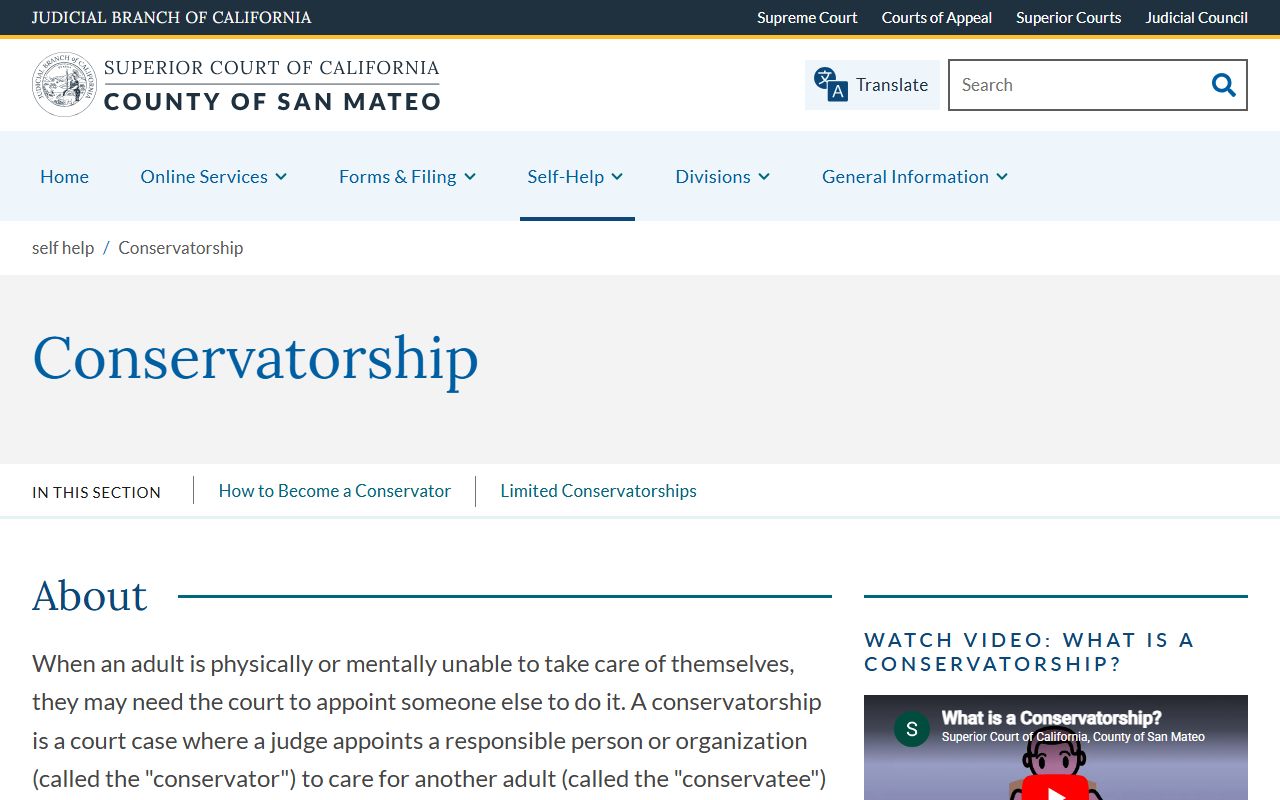
The page lists CARE Court materials and points to the Family Law Facilitator for help with petitions and orders. Guardianship of a minor follows a parallel path on the San Mateo County guardianship self-help page, which covers when a guardian is needed, who can ask, and what proof the judge will want.
Self-Help for San Mateo County Probate
Self-help is a real part of the San Mateo County probate process. The court runs a Self-Help Center and a Family Law Facilitator at the Hall of Justice and Records. Staff cannot give legal advice, but they can hand out forms, point to the right code section, and check that a petition is complete before it reaches the clerk. LiveChat is open for many topics, including probate.
The statewide California Courts site holds plain-language guides that map well onto a San Mateo case. The California Courts probate self-help page covers wills, small estates, guardianship, and conservatorship in steps. The court's local self-help menu also points to it. Many San Mateo filers start with the state page, then move to the local Probate Division page for hearing calendars and filing notes.
Local legal aid groups also help. The Legal Aid Society of San Mateo County, at 330 Twin Dolphin Drive, Suite 123, Redwood City, gives free advice on some civil matters to people with low income. Bay Area Legal Aid runs a Domestic Violence Restraining Order Clinic at (650) 358-0745 and may screen probate-adjacent issues for survivors. The county Bar Association keeps a lawyer referral service for people who need paid help.
Restricted San Mateo County Probate Records
Not every San Mateo County probate file is open to the public. State law and the California Rules of Court keep some material out of the public view. The Probate Division applies those rules at the clerk's counter, and the Odyssey Public Portal does the same online. A user who hits a blank screen or a "no result" message on a known case is often running into one of these limits.
Sealed records under Rules 2.550 and 2.551 are the broadest block. A judge must find specific facts before sealing any probate paper, and unsealing follows the same rule. Mental health files have their own state-law shield, and the court says mental health case information is not posted online. Adoption records under Family Code section 9200 are also kept out of public search and out of the Odyssey portal. Guardianship of minors and many conservatorship documents may carry redactions for the ward, the proposed conservatee, and any minor children named in pleadings.
Identifiers are scrubbed too. California Rule of Court 2.503 and state privacy law block public display of dates of birth, social security numbers, driver license numbers, financial account numbers, and home addresses in many filings. Probate Court Investigator reports, medical declarations, and capacity declarations are also restricted. For broader rules on what the court releases and what it withholds, the public records page sets out the framework, and the court records page covers MIDX and Odyssey use across all case types.