
San Mateo County Superior Court Overview
California has one trial court in each county. It is called the Superior Court. The Superior Court of California, County of San Mateo, hears every kind of state case for the county. That means civil, criminal, family law, probate, juvenile, traffic, small claims, mental health, and unlawful detainer. There is no Municipal Court, no Justice Court, no County Court, and no separate probate court in California. The state ended that split when voters passed Proposition 220 in 1998 and the counties merged their trial courts.
The court sits in the County Center campus in Redwood City and runs four branches across the county. Its main number is (650) 261-5100. The court's public website is sanmateo.courts.ca.gov. The Court Executive Officer acts as Clerk of the Superior Court. The Records Management Division at the Hall of Justice and Records holds public case files. A separate office, the County Clerk-Recorder at 555 County Center, handles marriage licenses, birth and death certificates, and recorded real estate documents, not court cases.
For online case lookup, see court records. For hearing calendars, see court dockets. For copy and certified-copy requests, see Clerk of the Superior Court.
Note: The County Clerk-Recorder is not the same office as the court clerk; do not mail court case requests to 555 County Center.
Four Branches of the San Mateo Superior Court
The court has four branch locations. The main branch is the Hall of Justice and Records in Redwood City. The Northern Branch in South San Francisco runs the Traffic Division. The Central Branch in San Mateo hears small claims and unlawful detainer matters. The Juvenile Branch in San Mateo handles delinquency and dependency. Each branch shares the same main court phone, (650) 261-5100. The table lists each branch with its address and the case types it holds.
The directory of locations was confirmed against the official court phone-hours page. View the source on the San Mateo Superior Court locations and phone hours page. The screenshot below shows the official court judges directory, which lists the bench by department and branch.
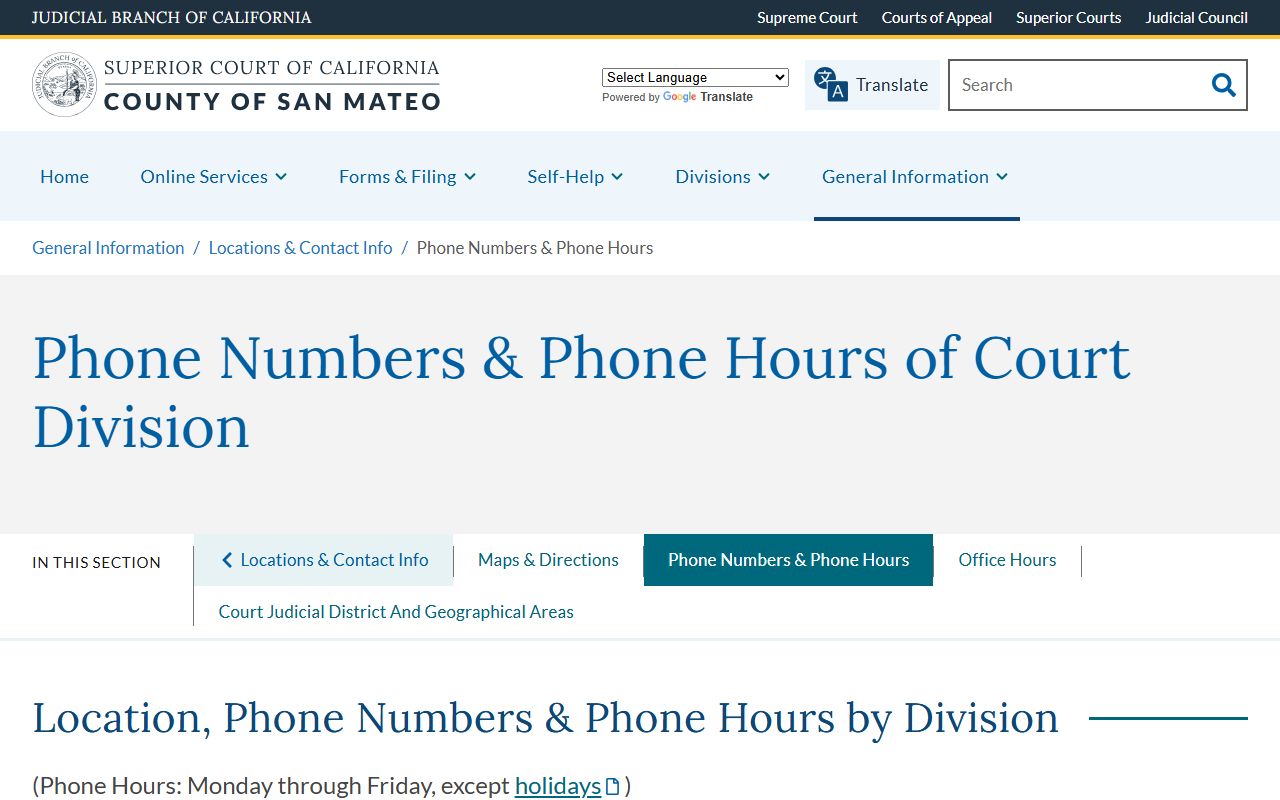
Use the table to plan a visit. Branch hours and phone hours change by division. Records Management public viewing hours run from 8:30 a.m. to 1:00 p.m., Monday through Friday. Criminal phone hours run from 8:00 a.m. to 4:00 p.m.
| Branch | Address | Phone | Case Types |
|---|---|---|---|
| Hall of Justice and Records (Southern Branch) | 400 County Center, Redwood City, CA 94063 | (650) 261-5100 | Civil, criminal, family, probate, small claims, appeals, jury, civil grand jury, records management |
| Northern Branch | 1050 Mission Road, South San Francisco, CA 94080 | (650) 261-5100 | Traffic Division |
| Central Branch | 800 N Humboldt Street, San Mateo, CA 94401 | (650) 261-5100 | Small claims, unlawful detainer |
| Juvenile Branch | 222 Paul Scannell Drive, San Mateo, CA 94402 | (650) 261-5100 option 8 | Juvenile delinquency and dependency |
San Mateo County Superior Court Divisions
Within the court, work is split into divisions. Each division has its own clerk's office, phone option, and rules. Most divisions sit at the Hall of Justice and Records, but Traffic sits at the Northern Branch and Juvenile sits on Paul Scannell Drive. Phone hours are not the same as counter hours.
- Civil: unlimited and limited civil cases, including contract, tort, and unlawful detainer matters. Phone hours 8:30 a.m. to 1:00 p.m.
- Criminal: felonies, misdemeanors, arraignments, bail, and sentencing. 4th Floor, 400 County Center. Phone hours 8:00 a.m. to 4:00 p.m.
- Family Law: divorce, custody, support, and restraining orders. Records limited online by California Rules of Court.
- Probate: wills, trusts, estate administration, conservatorships, and guardianships. Court Investigators at the 8th Floor.
- Juvenile: delinquency and dependency matters; records are restricted by Welfare and Institutions Code section 827.
- Traffic: citation matters at 1050 Mission Road, South San Francisco. Phone hours 8:00 a.m. to 4:00 p.m.
- Small Claims: civil claims up to $12,500 for individuals, heard at Hall of Justice and Central Branch.
For copies of records from any of these divisions, see court records. For probate-specific filings and the inventory of probate documents, see probate records. For arraignment and felony case files, see criminal records.
Superior Court vs U.S. District Court
People often mix up the state Superior Court with the federal U.S. District Court. They are two separate court systems. State law cases go to Superior Court. Federal law cases go to U.S. District Court for the Northern District of California, which sits in San Francisco, Oakland, and San Jose. The comparison block below shows the basic split.
| San Mateo County Superior Court | U.S. District Court, Northern District of California | |
|---|---|---|
| Jurisdiction | State law, San Mateo County | Federal law and federal-question matters across the Northern District |
| Case Types | Civil, criminal, family, probate, juvenile, traffic, small claims, unlawful detainer | Federal crimes, civil rights, federal statutes, diversity cases, federal employment, federal tax |
| Appeals Path | California Court of Appeal, First Appellate District, then Supreme Court of California | U.S. Court of Appeals for the Ninth Circuit, then U.S. Supreme Court |
| Records Portal | MIDX and Odyssey Public Portal | PACER and CM/ECF (ecf.cand.uscourts.gov) |
| Bankruptcy | Not heard here | U.S. Bankruptcy Court, Northern District of California (canb.uscourts.gov) |
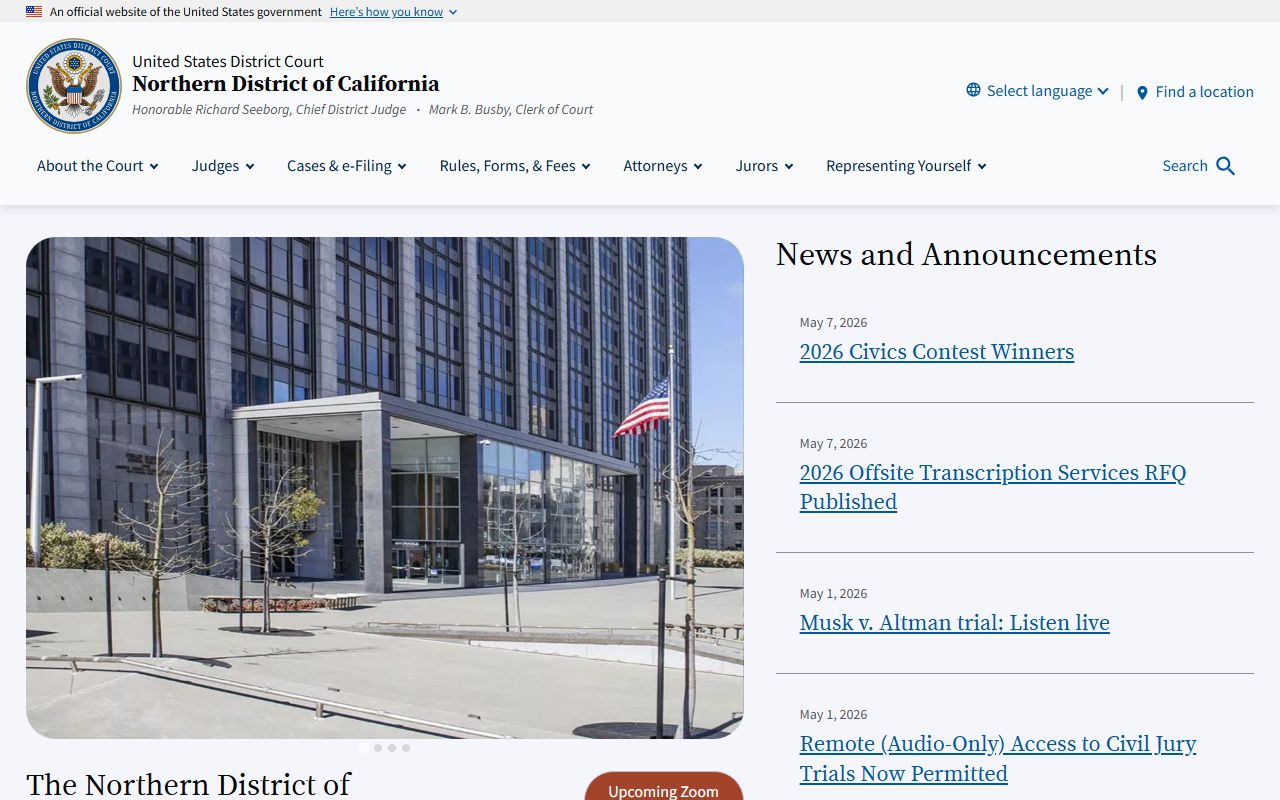
For the official federal court page, see the U.S. District Court for the Northern District of California. The image below is the front page of that federal court.
Note: A federal party or a federal question does not turn a state case into a federal case; the federal court still has to have its own jurisdiction.
How a Case Moves Through the System
The state and federal tracks each have a clear appeals path. Trial happens at the Superior Court or the federal district court. The losing party may then ask the next court to review the case. The state side ends at the Supreme Court of California; the federal side ends at the U.S. Supreme Court.
State track: Superior Court of California, County of San Mateo (Limited / Unlimited) › California Court of Appeal, First Appellate District › Supreme Court of California
Federal track: U.S. District Court, Northern District of California › Ninth Circuit Court of Appeals › U.S. Supreme Court
Small claims and limited civil appeals go to the Appellate Division of the San Mateo Superior Court, not the Court of Appeal. Unlimited civil, felony, family, and probate appeals go to the First District Court of Appeal in San Francisco.
- Case is filed and heard in trial court (Superior or federal district).
- Judgment is entered.
- Losing side may file a notice of appeal within the time set by court rules.
- The appellate court reviews the record and any briefs.
- If the appellate court rules, a party may petition the high court for review.
San Mateo Superior Court Specialty Courts
The court runs several collaborative courts. These are post-plea calendars that combine court oversight with treatment, services, and probation supervision. The goal is fewer return arrests and better life outcomes. Each one is part of the Criminal Division and listed under the Collaborative Court menu on the court site.
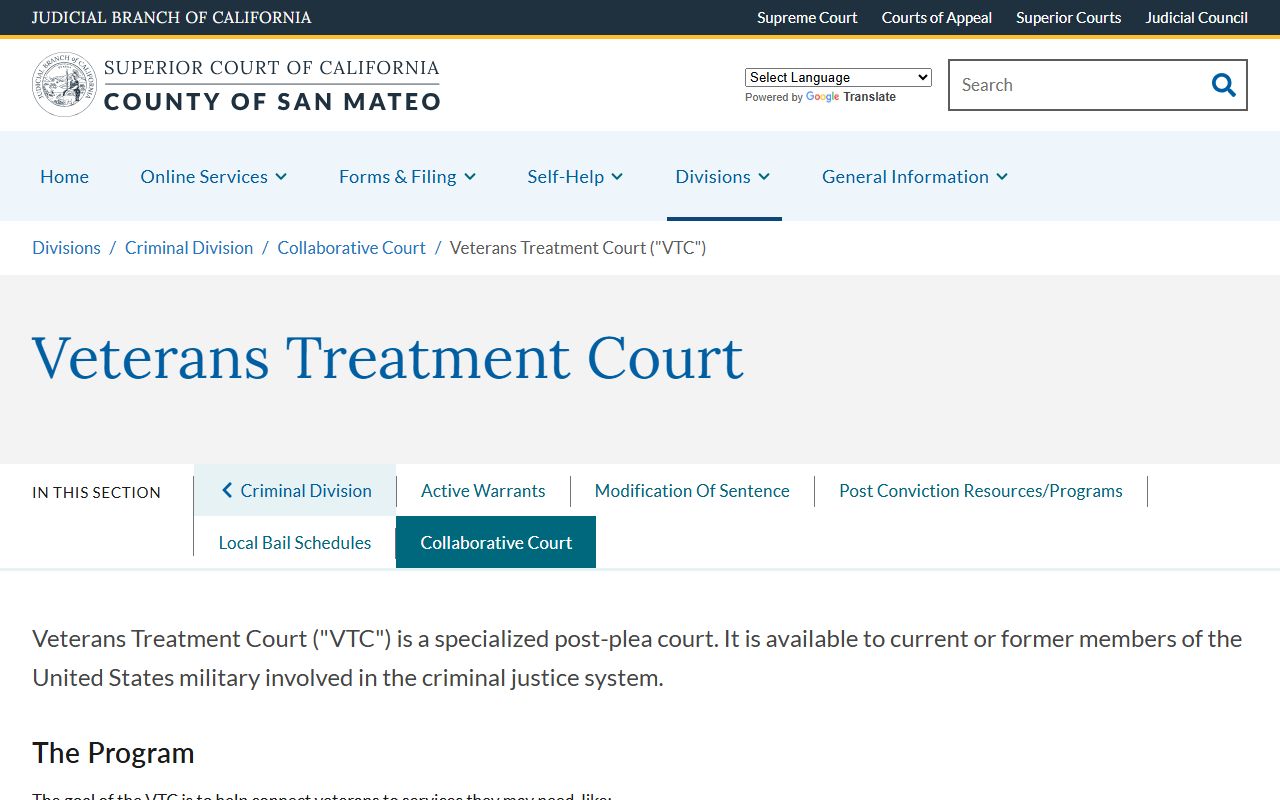
- Veterans Treatment Court: for current or former U.S. military members in the criminal justice system. Links veterans to mental health and substance use care, VA benefits, job training, and housing help. Supervised by a Deputy Probation Officer.
- Behavioral Health Court: for people with serious mental illness whose cases can be served by treatment instead of plain custody.
- Drug Court: for eligible people with substance use disorders, with court reviews, drug testing, and treatment plans.
- DUI Court: for repeat DUI offenders, with monitoring and treatment built into the calendar.
- CARE Court: California's civil treatment-focused process for people with schizophrenia spectrum or other psychotic disorders.
The Veterans Treatment Court page is the clearest source for how these calendars work. See the Veterans Treatment Court official page for eligibility and process. The screenshot below shows that page.
San Mateo County Civil Grand Jury
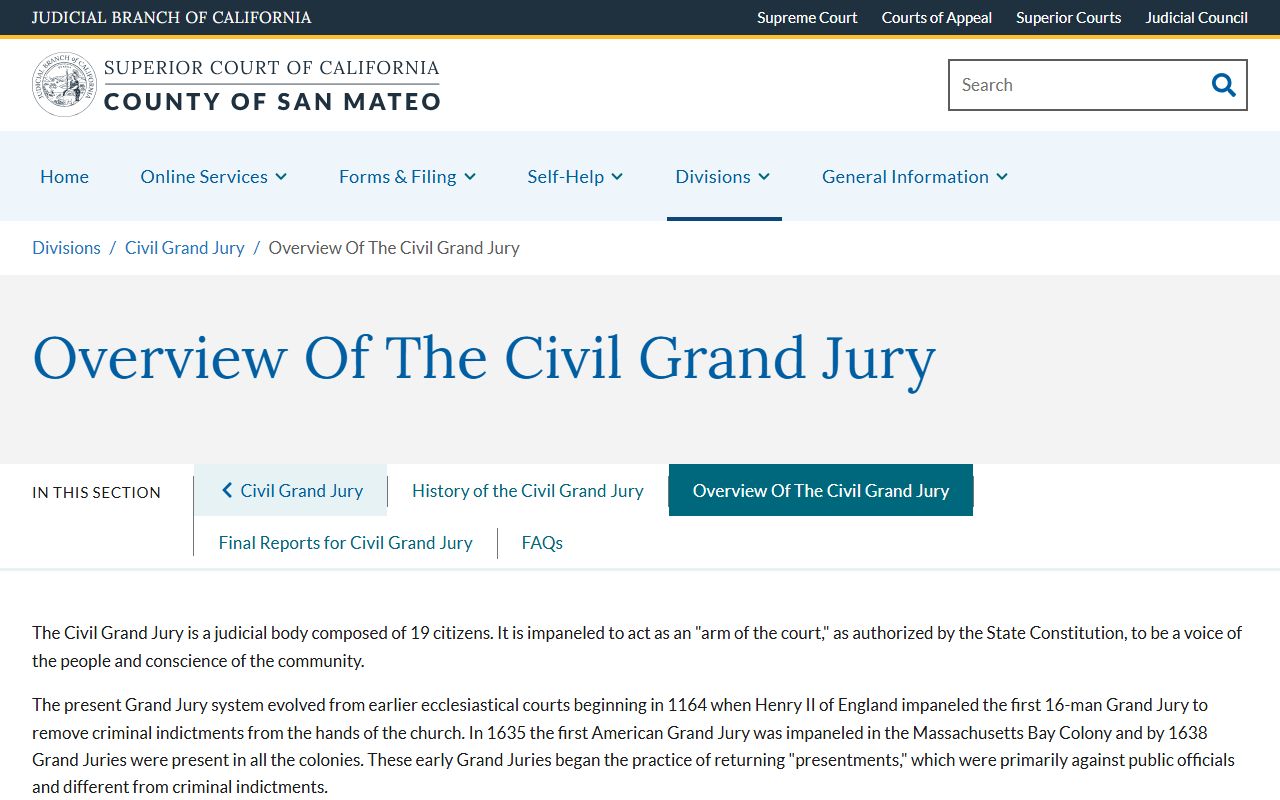
The Civil Grand Jury is not a treatment court. It is a 19-citizen body created under the California Constitution. The court describes it as a watchdog and ombudsperson for county residents. It investigates the actions of county and city government, looks into complaints about officials, and may issue reports with recommendations for change. The Civil Grand Jury is an arm of the Superior Court, but it does not handle criminal indictments. If indictments are needed, the court impanels a separate criminal grand jury.
The jury is selected once a year. Volunteers apply through the court, and the presiding judge of the Superior Court oversees the impaneling. Reports are public and posted on the court site. The full overview is on the San Mateo Civil Grand Jury overview page. The image below shows that page.
Note: The Civil Grand Jury issues reports only; it cannot enforce its recommendations or punish anyone.
Judges of the San Mateo County Superior Court
The bench includes judges and commissioners assigned to civil, criminal, family, probate, juvenile, traffic, and collaborative calendars. The court keeps a current judges directory online with names, departments, and branches. New assignments are made each year. The presiding judge sets the master calendar and makes administrative orders for the court.
To view the full list, see the directory of San Mateo Superior Court judges. People who plan to file a peremptory challenge under Code of Civil Procedure section 170.6 should confirm their judge's current department before filing.
Most courtrooms post tentative rulings the court day before the hearing. Tentative rulings are not final orders; they show how the judge is leaning. A party that wants to argue must contest the ruling under local rule. Hearings can be in person at the branch courtroom or by remote video for many civil and family calendars.
San Mateo County Indigent Defense
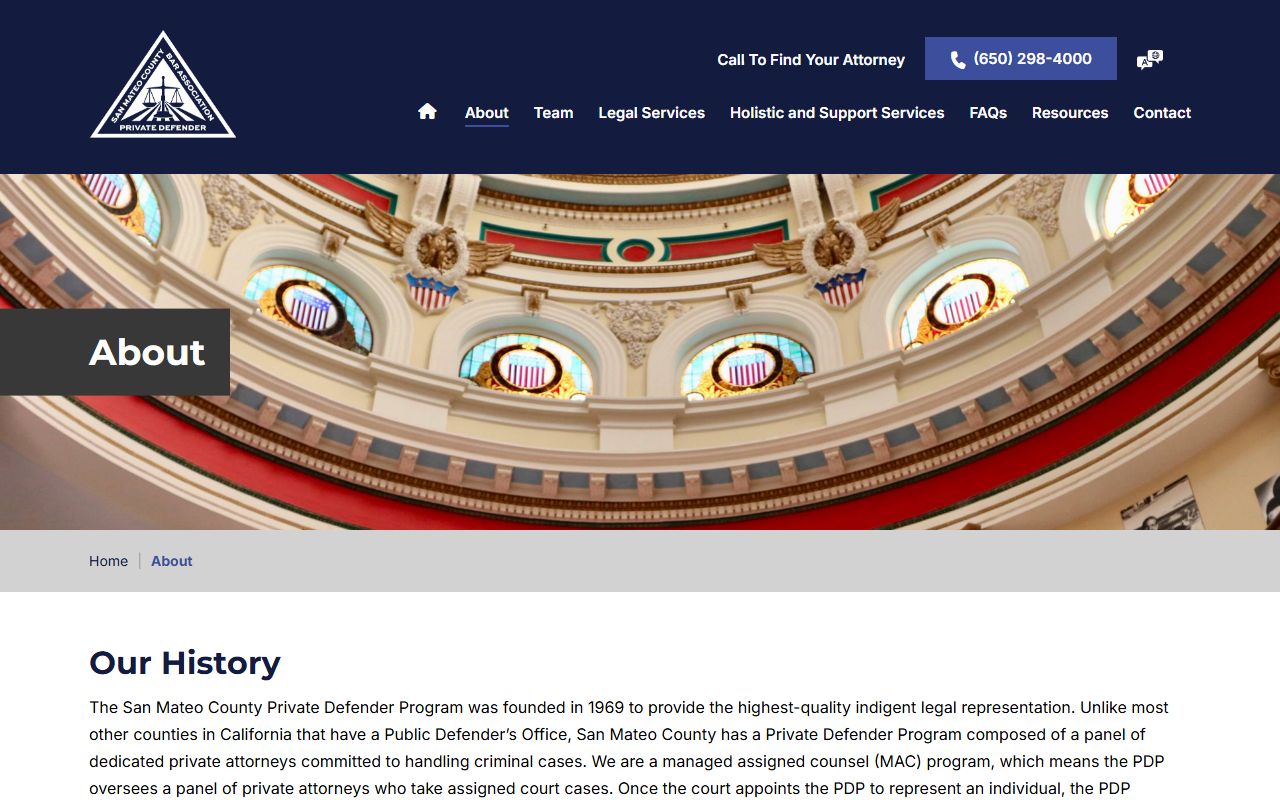
San Mateo does not have a traditional Public Defender's Office. Instead, the county uses the Private Defender Program, or PDP. PDP was founded in 1969 and operates as a managed assigned counsel panel of private attorneys. Once the court appoints PDP to a case, PDP assigns a panel lawyer with the right level of skill for the charge. This model is unusual in California; most counties run a county-employed Public Defender. PDP also has a Chief Defender, managing attorneys for felony and misdemeanor work, investigators, social workers, and immigration counsel.
For details on the program, see the San Mateo County Private Defender Program official site. The PDP main phone is (650) 298-4000. The image below shows the PDP overview page.
On the prosecution side, the San Mateo County District Attorney, Stephen M. Wagstaffe, leads the office at 500 County Center, 3rd Floor, Redwood City. The main DA phone is (650) 363-4636. The DA prosecutes adult and juvenile state criminal cases in the Superior Court.
Federal Court for San Mateo County
Federal cases for residents of San Mateo County are heard in the U.S. District Court for the Northern District of California. The district has courthouses in San Francisco, Oakland, San Jose, and Eureka. The clerk's site is cand.uscourts.gov, and electronic filings go through CM/ECF at ecf.cand.uscourts.gov. National public access to federal court records is through PACER at pacer.uscourts.gov, which charges per-page fees subject to federal policy.
Appeals from the Northern District go to the U.S. Court of Appeals for the Ninth Circuit at ca9.uscourts.gov. Bankruptcy cases for the county go to the U.S. Bankruptcy Court for the Northern District of California at canb.uscourts.gov. Federal criminal cases are prosecuted by the U.S. Attorney's Office for the Northern District of California, and the U.S. Marshals Service handles federal warrants and prisoner transport.
Federal inmates are searched through the Bureau of Prisons inmate locator, not the local San Mateo jail tool. For state-side custody, see warrant records.
San Mateo Court History
San Mateo County was formed in 1856 from parts of San Francisco and Santa Cruz Counties. Court records date back to that founding. The first courthouse was a two-story building completed in February 1858 on land donated by Simon Mezes. The county's most well-known historic court building is the 1910 courthouse in Redwood City. It survived the 1989 Loma Prieta earthquake and now houses the San Mateo County History Museum. Modern case work has long since moved to the Hall of Justice and Records at 400 County Center.
The Superior Court of California, County of San Mateo, took its modern form in 1998 when California voters passed Proposition 220 and counties unified their trial courts. Before unification, the state had Municipal Courts for limited civil and misdemeanor cases and Superior Courts for unlimited civil and felony cases. After 1998, all of that work moved into a single Superior Court. San Mateo merged its courts under that statewide change.
The court's case system moved to Odyssey on June 15, 2016. Cases filed before that date keep older case-number formats. Cases filed after that date use the native Odyssey format of two-digit year, a three-letter case-type prefix (CIV, CLJ, FAM, PRO, SCS), and a number. The court keeps MIDX online as the public index.
Visiting the Main Courthouse
The Hall of Justice and Records at 400 County Center is the central courthouse. It is in the County Center government campus in Redwood City, off U.S. 101. Public records viewing happens at Records Management on the 1st Floor, Room A, Monday through Friday from 8:30 a.m. to 1:00 p.m. People may view up to five files at once, and may ask for five more after returning the first set. The court does not research files for the public.
Court visitors should plan for security screening at the entry. Off-site files cost $10 each, must be ordered in person, and are usually ready within 72 hours. Caltrain stops at the Redwood City station, which is a short walk to the County Center campus. The District Attorney is one block over at 500 County Center, and the County Clerk-Recorder is at 555 County Center, so users often combine trips.
Hall of Justice and Records
San Mateo County Superior Court
400 County Center
Redwood City, CA 94063
Phone: (650) 261-5100
Records Management: 1st Floor, Room A
Public Hours: Mon-Fri, 8:30 a.m. to 1:00 p.m.
Website: sanmateo.courts.ca.gov
Note: Juvenile case files are not handled at the regular records counter; call the Juvenile Clerk at (650) 261-5100 option 8 before going to a juvenile branch.