
California Public Records Act
The California Public Records Act, or CPRA, is the baseline open-records law for state and local agencies. The Legislature recodified the CPRA in 2021 under Assembly Bill 473. The new section numbers took effect on January 1, 2023 and now live in Government Code section 7920.000 through 7930.000. The old section 6250 cites have been retired, though older request letters and policies still reference them. The Act covers writings, emails, data, photos, and audio held by county departments while doing the public's business. It does not cover court case files. Those follow a separate court access path.
Any person can ask for records. There is no residency rule and no need to give a reason. A San Mateo County department must reply within ten days. The reply must say if the agency has the record and if it will release the record. The Act allows a fourteen-day extension in unusual cases. The balancing test in Government Code section 7922.000 lets an office withhold a record when the public interest in privacy clearly outweighs the public interest in release. Law-enforcement records have their own rule under Government Code section 7923.610, which says what must come out and what may stay in.
The lead-in shot below shows the official short-title statute that names Division 10 of the Government Code as the California Public Records Act. View the live page at leginfo.legislature.ca.gov for the current text. The Legislative Counsel posts plain-text statute pages that work well for printing or for citing in a follow-up request.
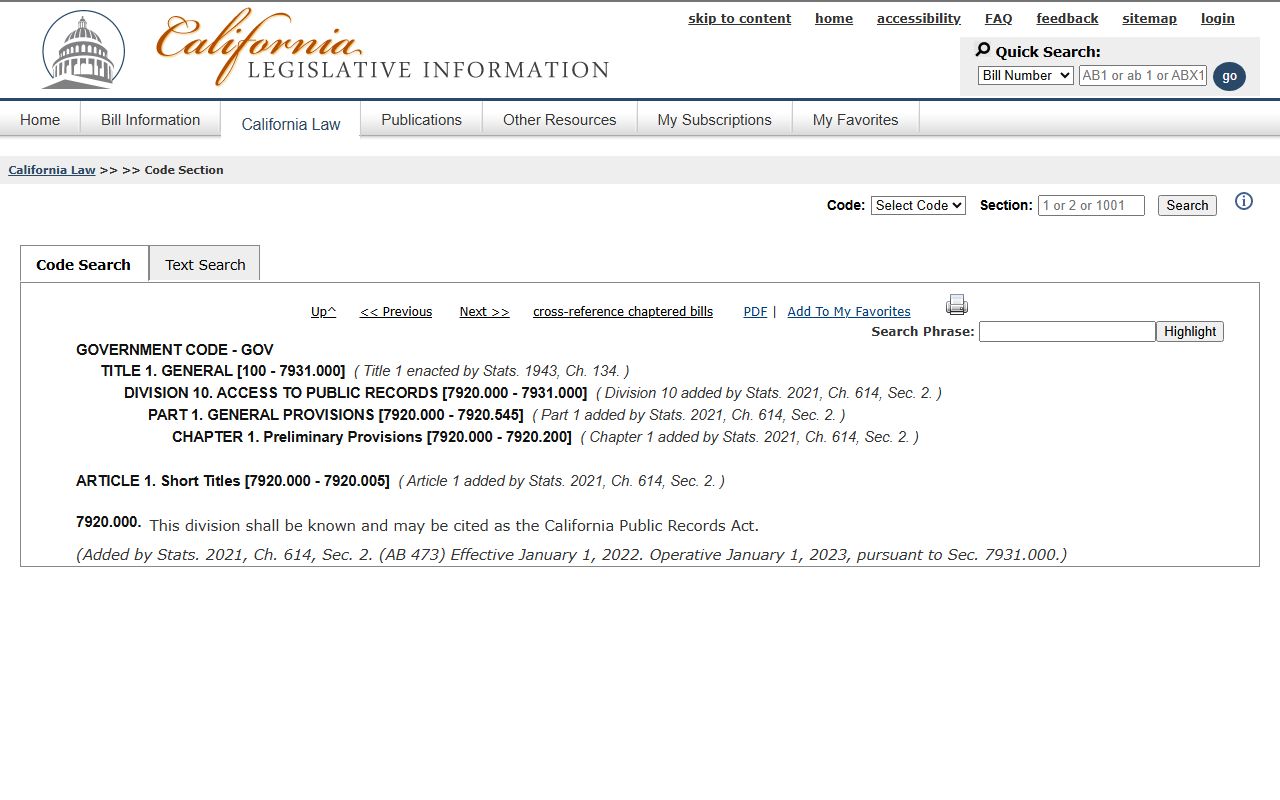
The statute page is short by design. The real rules live in the sections that follow, mainly the balancing rule, the response timing rule, and the law-enforcement provisions. Print the section that matches your request and attach it to your letter if a clerk pushes back.
Court Records vs County Records
San Mateo County users mix up court records and county records all the time. The two tracks have different laws, different forms, and different fees. Case files at the Superior Court follow California Rules of Court, rule 2.500 through 2.504. Judicial administrative records at the court follow rule 10.500. County agency records follow the CPRA. The table below pairs the two so you can pick the right path before you write a letter.
| Topic | Court Records (Rule 2.500) | County Records (CPRA) |
|---|---|---|
| Governing law | California Rules of Court, rule 2.500 to 2.504; rule 10.500 for administrative files | Government Code sections 7920.000 to 7930.000 |
| Who holds the file | Clerk of the Superior Court, Records Management Division | Sheriff, DA, Clerk-Recorder, Assessor, other county agencies |
| Reply window | About 30 days for mailed case-copy requests | 10 days, with a 14-day extension in unusual cases |
| Standard fee | 50 cents per side for plain copies; $40 to certify | Direct cost of duplication; sometimes free |
| Where to file | 400 County Center, 1st Floor Room A, Redwood City | The agency that holds the record |
| Appeal route | Motion or petition in the same court | Writ of mandate under section 7923.000 |
Note: Court records are not CPRA records. A letter mailed to the Superior Court that cites only the CPRA may sit until staff reroute the file.
What the County Holds
Each county office holds a different slice of the public file. The San Mateo County Clerk of the Superior Court manages case files for civil, criminal, family, probate, and small claims matters. The County Clerk-Recorder at 555 County Center handles vital records and recorded real estate, plus fictitious business name filings and notary oaths. The Sheriff holds custody, booking, and incident files. The District Attorney holds prosecution files. The Assessor holds property data. Knowing the holder saves a week.
- Sheriff: arrest logs, booking sheets, jail rosters, incident reports, body-camera footage
- District Attorney: charging records, case-status data, victim-services contact, press releases
- Clerk-Recorder: deeds, liens, maps, fictitious business names, vital records like birth, death, and marriage
- Assessor: parcel data, ownership rolls, assessed values
- Superior Court: case files, dockets, tentative rulings, judicial administrative records
The Clerk-Recorder home page lists fees, hours, and the service menu. Visit smcacre.gov for the full list. The office sits at 555 County Center, 1st Floor, Redwood City. Walk-ins are welcome and the office runs a self-service appointment tool for busy days.
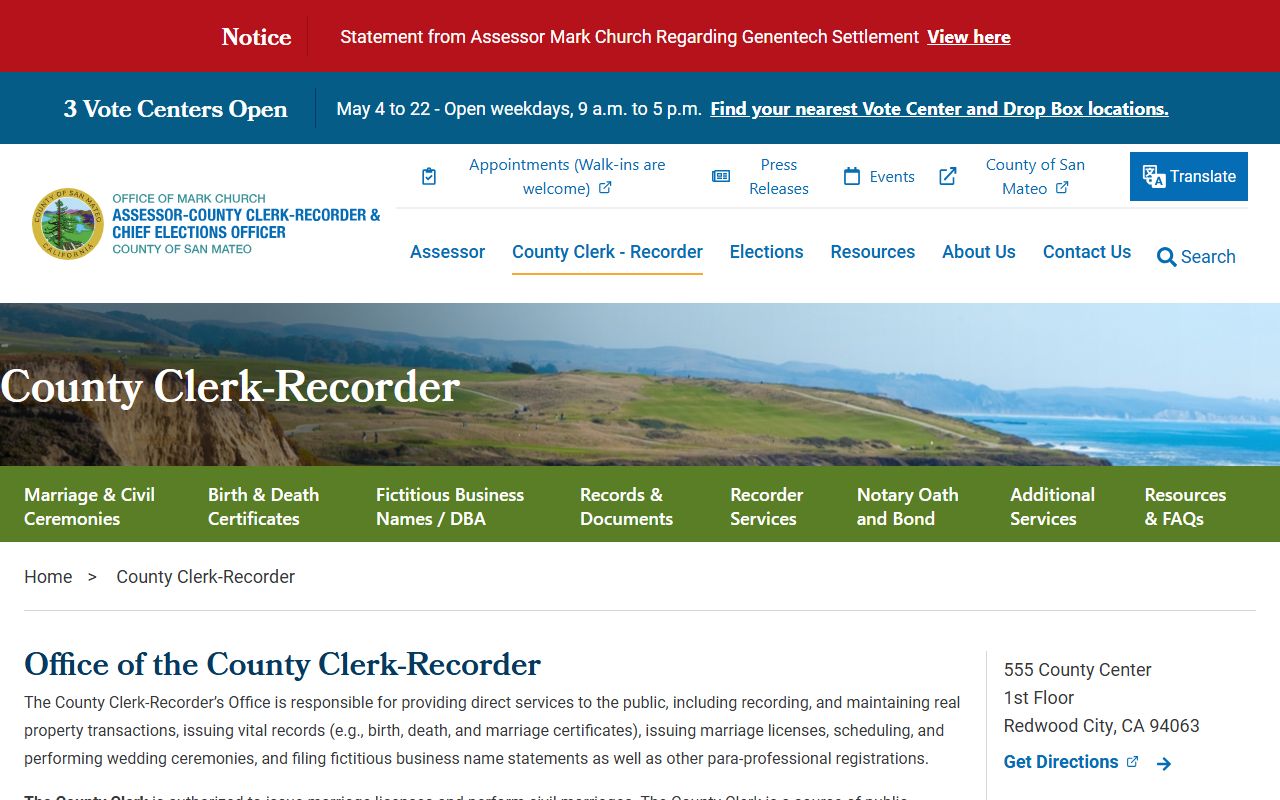
The home page is the right landing for most county filings that are not court files. The grantor-grantee index on the same site lets you search recorded real estate by name. The vital records pages handle marriage, birth, and death copy requests. Court case copies do not live here. Those go to the Hall of Justice and Records.
How to File a San Mateo County Public Records Request
The steps below match the path most county offices follow. Pick the agency first. Write a short, clear letter. Send it by email or mail. Wait for the ten-day reply. Pay the fee. Pick up or receive the file. Skip any step and the response drags out.
- Name the agency that holds the record. Sheriff for jail and incident files. DA for prosecution files. Clerk-Recorder for deeds and vital records. Superior Court for case files. Email or call ahead if you are not sure.
- Write a request that lists names, dates, case numbers, addresses, or report numbers. Vague requests slow the search. A focused request with a date range gets the fastest reply.
- Send the request by email, by mail, or through the agency online form. Address it to the Public Records Officer or Custodian of Records. The Clerk-Recorder accepts mail at 555 County Center, 1st Floor, Redwood City, CA 94063. The court Records Management mail address is 400 County Center, 1st Floor Room A, Redwood City, CA 94063.
- Wait up to ten days for the first reply. The agency must say if it holds the record and if it will release the record. The office may take a fourteen-day extension when the search is hard or the record is large.
- Pay the copy or search fee shown on the response. The Clerk-Recorder takes cash, check, or card in person, and a preprinted U.S. bank check by mail. The court takes a blank check made out to "Superior Court" with a "not to exceed" line in the memo. Receive the records by mail, email, or in-person pickup.
Note: Court case-copy mail requests reply within about 30 days, not ten. Records Management does not research files for you, so include the case number when you can.
San Mateo County Records Agencies
The contact list below covers the four offices that field the most public records traffic. Phone numbers and addresses come from each agency's own page. Hours run Monday through Friday in nearly every case. Weekends are closed.
| Agency | Address | Phone | Holds |
|---|---|---|---|
| County Clerk-Recorder (ACRE) | 555 County Center, 1st Floor, Redwood City, CA 94063 | (650) 363-4500 | Deeds, vital records, fictitious business names |
| Sheriff's Office | 400 County Center, Redwood City, CA 94063 | (650) 363-4911 | Arrest, jail, incident files, body-cam |
| District Attorney | 500 County Center, 3rd Floor, Redwood City, CA 94063 | (650) 363-4636 | Charging and case files, victim services |
| Superior Court Records Management | 400 County Center, 1st Floor Room A, Redwood City, CA 94063 | (650) 261-5100 | Case files and certified copies |
Sheriff Kenneth Binder leads the Sheriff's Office after his swearing-in on November 12, 2025. Stephen M. Wagstaffe leads the DA's Office. Mark Church is the elected Assessor-County Clerk-Recorder. Email for the Clerk-Recorder is countyclerk@smcacre.gov. Email for the court's administrative records team is administrativerecords@sanmateocourt.org.
Public Records Request Form Fields
San Mateo County offices do not all use the same form, but each request should carry the same core fields. The table below maps out what to include so the office can route your file fast. Required fields keep the search clean. Optional fields like date range and delivery format save back-and-forth emails.
| Field | Required | Notes |
|---|---|---|
| Requester Name | Yes | Full legal name; an alias slows the file match. |
| Mailing Address | Yes | Used for mailed copies and for billing the fee. |
| Email and Phone | Yes | The office calls or emails before the search starts. |
| Agency Receiving Request | Yes | Sheriff, DA, Clerk-Recorder, Assessor, or court division. |
| Description of Records | Yes | Names, case numbers, report numbers, parcel numbers, or addresses. |
| Date Range | No | A narrow range cuts search time and fees. |
| Delivery Format | No | Paper, PDF on disc, or email attachment. |
| Commercial Use Statement | Conditional | Required for rule 10.500 administrative-record requests at the Superior Court. |
| Fee Waiver Request | No | The CPRA does not require a waiver, but many offices grant one in the public interest. |
| Signature and Date | Yes | Email signatures count when the request is sent from a matching email account. |
The Superior Court page for judicial administrative records lists the same core fields, plus the commercial-use box. The court inbox is administrativerecords@sanmateocourt.org. The screenshot below shows the official entry point.
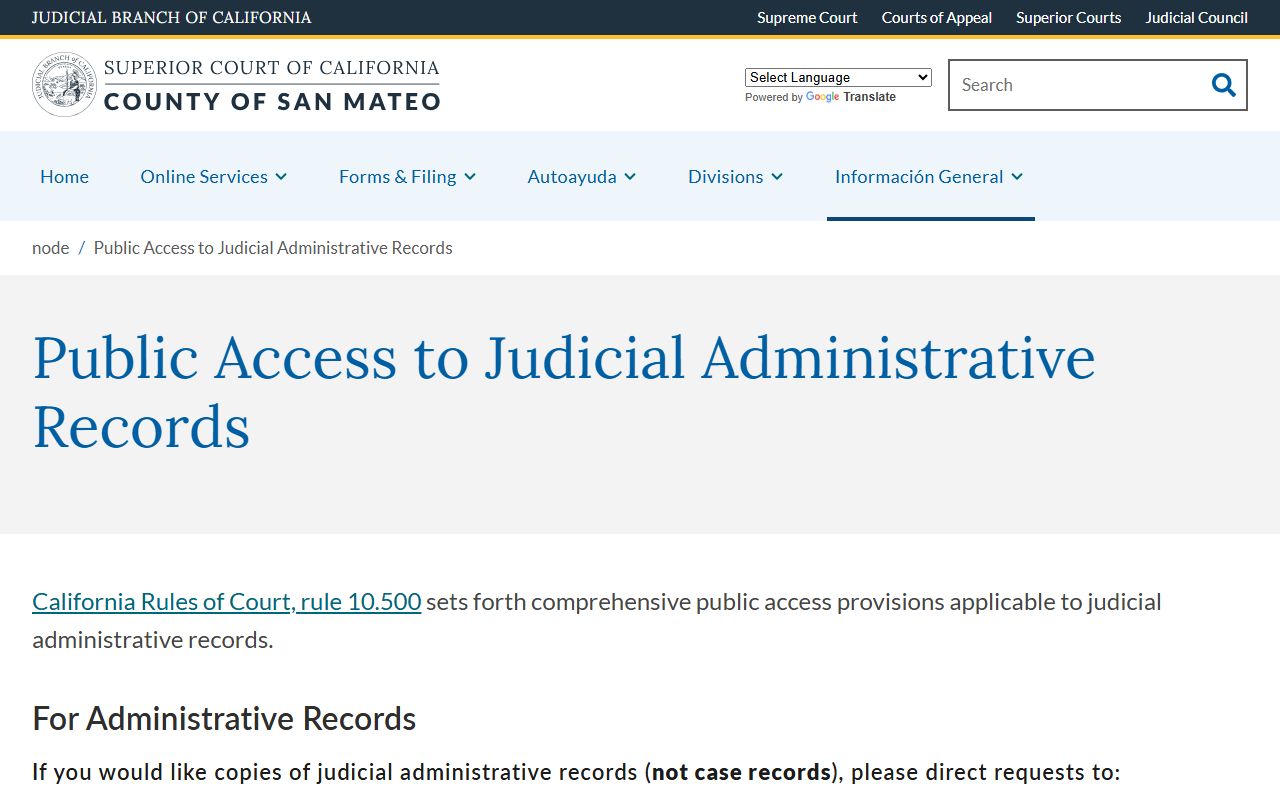
The page at sanmateo.courts.ca.gov spells out the rule 10.500 process for court administrative records. It is the right channel for things like court budgets, policies, and internal staff records. It is not the channel for case files.
Response Timelines and Replies
The CPRA gives county offices ten days to reply. The reply must say if the office has the record and if it will release it. The Act allows a fourteen-day extension when the office must consult with another agency, search a large set of files, or redact a long record. Sheriff and DA files often take the full window because of redaction work under section 7923.610.
Court case-copy mail requests run on a 30-day schedule, not the CPRA clock. The court's court records page covers the mail process in detail. Walk-in copy requests at Records Management can be filled the same day if the file is on site. Off-site retrieval adds a few business days because the file ships back from a storage center.
Note: A response is not the records. The office may reply within ten days and still need more time to deliver the file. Track the date stamp on your letter and follow up if the office goes silent.
San Mateo County Public Records Fees
CPRA fees are limited to the direct cost of duplication. Many county offices charge less than that, or nothing for small electronic files. The Clerk-Recorder uses a flat per-page schedule for recorded documents. The Superior Court uses a separate fee schedule for case copies. The numbers below come straight from official fee pages.
| Item | Amount |
|---|---|
| Court copy of any record on file (per side) | $0.50 |
| Certifying a copy at the Superior Court | $40.00 |
| Court exemplification | $50.00 |
| Court search longer than 10 minutes | $15.00 |
| Retrieval of court file stored off-site | $10.00 |
| Certified copy of dissolution record | $15.00 |
| Clerk-Recorder recorded document, first page | $5.00 |
| Clerk-Recorder recorded document, each additional page | $1.00 |
| Clerk-Recorder certification of recorded document | $5.00 plus copy fees |
| Clerk-Recorder conformed copy | $10.00 |
| Clerk-Recorder research files | $20.00 |
| Birth certificate, general public | $34.00 |
| Death certificate | $26.00 |
| Marriage certificate, general public | $19.00 |
Sheriff and DA records often release for free when the file is short and digital. A long file with body-cam footage and redactions can carry a higher direct-cost fee. The agency must show the cost breakdown if you ask. Fee waivers are not required by the CPRA, but the offices grant them in many public-interest cases.
Records That Stay Closed
Not every record is public. Some files stay closed by statute. Others stay closed under the balancing rule in section 7922.000 when the privacy harm is clear. The list below covers the main blocks a requester hits in San Mateo County. The agency must say which section it is using when it withholds a record.
- Juvenile case files under Welfare and Institutions Code section 827
- Adoption records under Family Code section 9200
- Mental health case files and CARE Court files
- Sealed arrest records under Penal Code section 851.91 or 851.93
- Active law-enforcement investigatory files under Government Code section 7923.610
- Personal identifiers like Social Security numbers, driver license numbers, medical and financial data
- Criminal grand jury proceedings, except indictments and records made public by law
Family law documents are not sealed, but they are not posted on the Odyssey Public Portal. The court holds those files at Records Management and releases them under court rules, not the CPRA. The same goes for paternity files. See marriage and divorce records for the family law path and probate records for estate files.
If Your Request Is Denied
A denial letter must cite a statute or rule. If the office cites section 7922.000 alone, ask the office to name the specific exemption. A short follow-up letter often gets a partial release or a fresh review. The CPRA does not run a state appeals office. There is no California Attorney General opinion path for a denial. The only formal route is court.
Government Code section 7923.000 lets a requester file a writ of mandate in the Superior Court. The court can order release if the record is public. The court can award attorney fees if the requester wins. Small claims is not the right venue. The petition must be filed in the Superior Court of California, County of San Mateo, at the Hall of Justice and Records, 400 County Center, Redwood City. Many requesters consult a lawyer at pdpsmcba.org or the legal-aid pages at smcgov.org before filing.
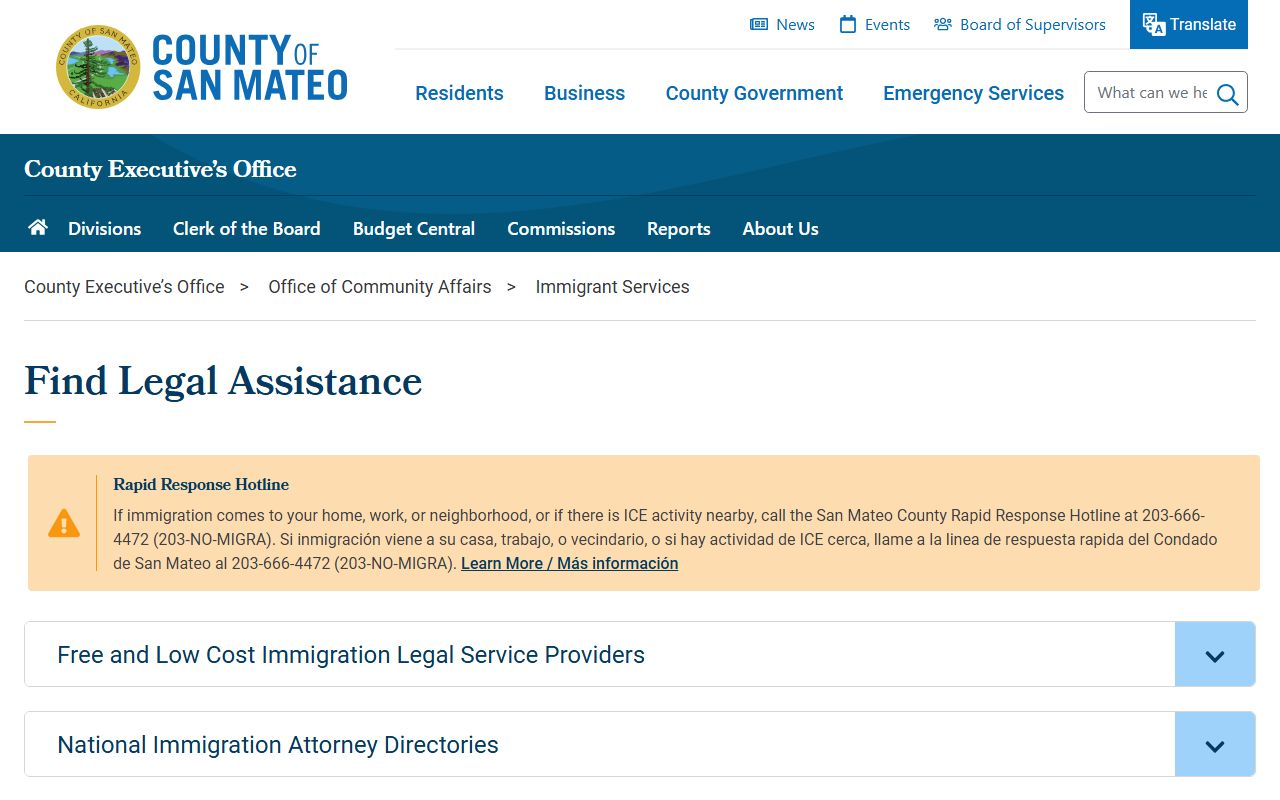
The county legal-assistance page lists free and low-cost help for immigration, housing, employment, and other civil matters. Some of the listed groups also help with CPRA letters when the record relates to housing, jail, or schools. The Private Defender Program handles indigent criminal defense and can advise on case-file access in pending cases.
Court Case File Path
Court case files in San Mateo County run through Records Management at the Hall of Justice and Records. The court takes mail requests at 400 County Center, 1st Floor Room A, Redwood City, CA 94063. Include the case number, the parties, an approximate filing date, a self-addressed stamped envelope, and a blank check made out to "Superior Court" with a "not to exceed" line on the memo. The court replies within about thirty days. Walk-in service is faster when the file is on site.
The online index for non-confidential cases is MIDX at web.sanmateocourt.org/midx. The register-of-actions portal is the Odyssey Public Portal at odyportal-ext.sanmateocourt.org. Neither portal shows juvenile, adoption, mental health, or family law documents. For arrest data, see criminal records. For docket entries, see the court records page.
Note: Court records are not CPRA records, so a CPRA letter to the court will be redirected. Use the rule 2.500 path for case files and rule 10.500 for court administrative records.