
How to Find Recently Released San Mateo County Inmates
The fastest free way to check is the official Sheriff's roster at smc-inmatelocator.org. The Sheriff's Office Inmate Locator screen is the entry point shown below. Type a first name and a last name, then run the search. The result page lists the facility, the case number, the next court date, and a "Projected Release Date" field. The projected release value often shows "Not Available," because release dates change with court action, bail posting, sentence credits, or transfer to state custody. If the name no longer appears on the roster, the person has most likely been released, transferred, or never booked under that exact spelling. Use the phonetic search box if you are not sure how the name is spelled.
The official 2016 Sheriff news release noted that members of the public without web access can still get inmate status 24 hours a day by phone. Call Maguire Correctional Facility at (650) 363-4000, extension 6070. Have the person's full name and correct date of birth ready before calling. The records line will not give out custody data without a verified DOB. If the locator returned no result, San Mateo County agencies may withhold names under California Public Records Act exemptions, so the next step is to contact the local police department that made the arrest. Keep notes on the date and time of each call, because release status can shift hour by hour.
Booking and custody info on the Inmate Locator updates in near real time, but court action can lag. The Sheriff's profile page shows a banner that reads "Charges and bail amounts changed during court proceedings may not be reflected in this record." If a hearing just happened that morning, wait a few hours and search again. Need the court file for the same person? Cross check the name in the Odyssey Public Portal or in San Mateo County inmate records for the current jail roster view.
A screenshot of the Sheriff's locator home page from smc-inmatelocator.org shows the search fields and the disclaimer block. 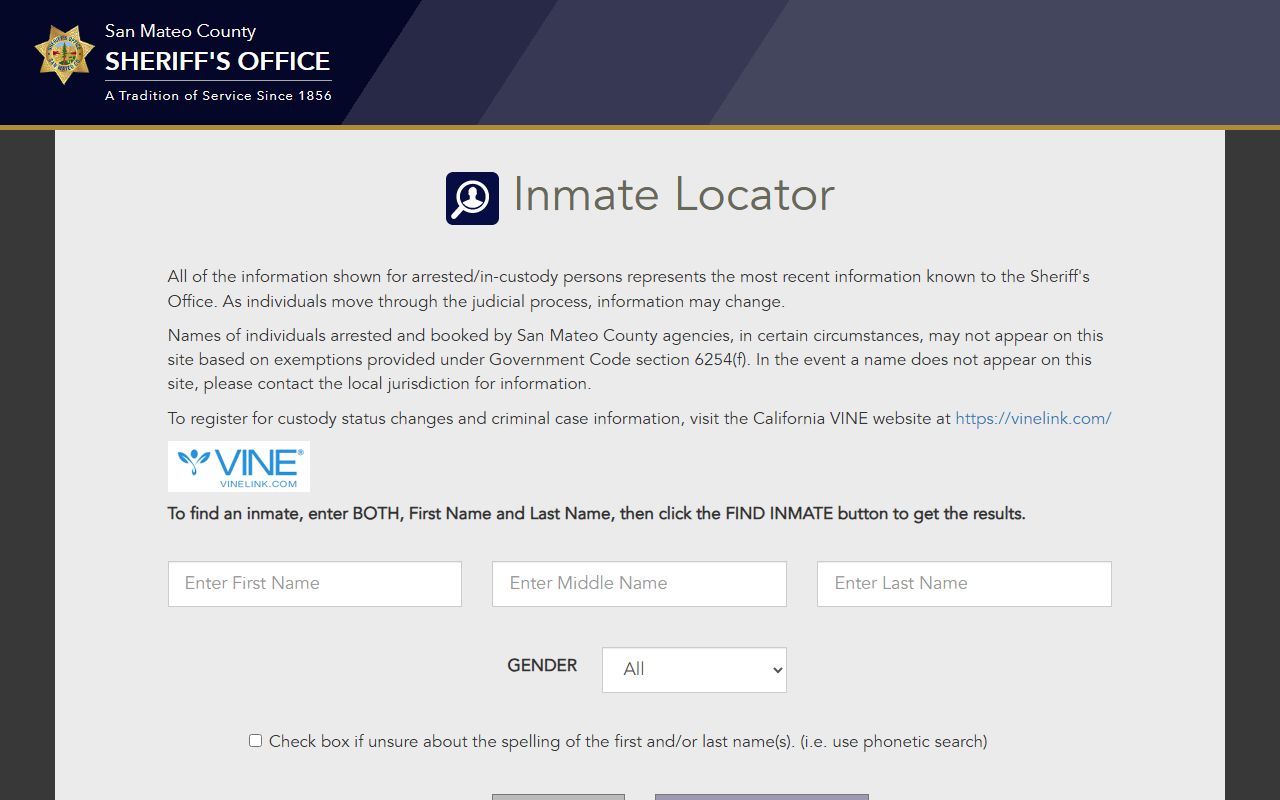 The page also links out to VINELink for custody status alerts, which is covered in the next section.
Note: The Sheriff's Inmate Locator only covers people booked into a San Mateo County jail, not state prison or federal custody.
Setting Up Release Notifications via VINELink
VINELink is the public face of the state VINE system, a free service that alerts crime victims and the public when an inmate moves, gets a court date, or is released. The tool is at vinelink.com. The Sheriff's Inmate Locator points users to VINELink for any custody status change and case information. VINELink covers most California county jails and state prisons. Sign-up is free. Alerts can come by phone call, text, email, or the VINE mobile app, depending on the user's choice. Most users get alerts within minutes of a status change, although the state notes that delivery time can vary.
How to Sign Up for VINELink Notifications
- Open vinelink.com and pick California from the state list.
- Type the inmate's name or ID into the search box and run the search.
- Open the matching profile and click the bell icon to register for alerts.
- Enter a phone number, an email address, or both, plus a four-digit PIN you can remember.
- Pick which event types should trigger an alert (release, transfer, court date, escape).
- Save the registration and watch for a test message confirming sign-up.
VINELink does not show every inmate. People held under sealed warrants, federal holds, or short pre-arraignment custody may not appear. Some agencies opt out of the public feed. If a VINELink search returns no result, fall back to the Sheriff's locator or the 24-hour line. Note: California VINE service is funded by the state Office of Emergency Services and stays free to use.
Searching State and Federal Released Inmates
People sent to state prison from a San Mateo County court are tracked by the California Department of Corrections and Rehabilitation, or CDCR. CDCR runs the California Incarcerated Records and Information Search, known as CIRIS. CIRIS is the public lookup at ciris.mt.cdcr.ca.gov. The CDCR home page lists "Search Population (CIRIS)" right under the Population menu. The tool covers adult inmates held in CDCR state institutions, fire camps, and contract beds. Parolees under state supervision are listed in CDCR parole files, but the public CIRIS view focuses on current and recent state inmate records.
A screenshot of the CDCR CIRIS search page from ciris.mt.cdcr.ca.gov appears below. 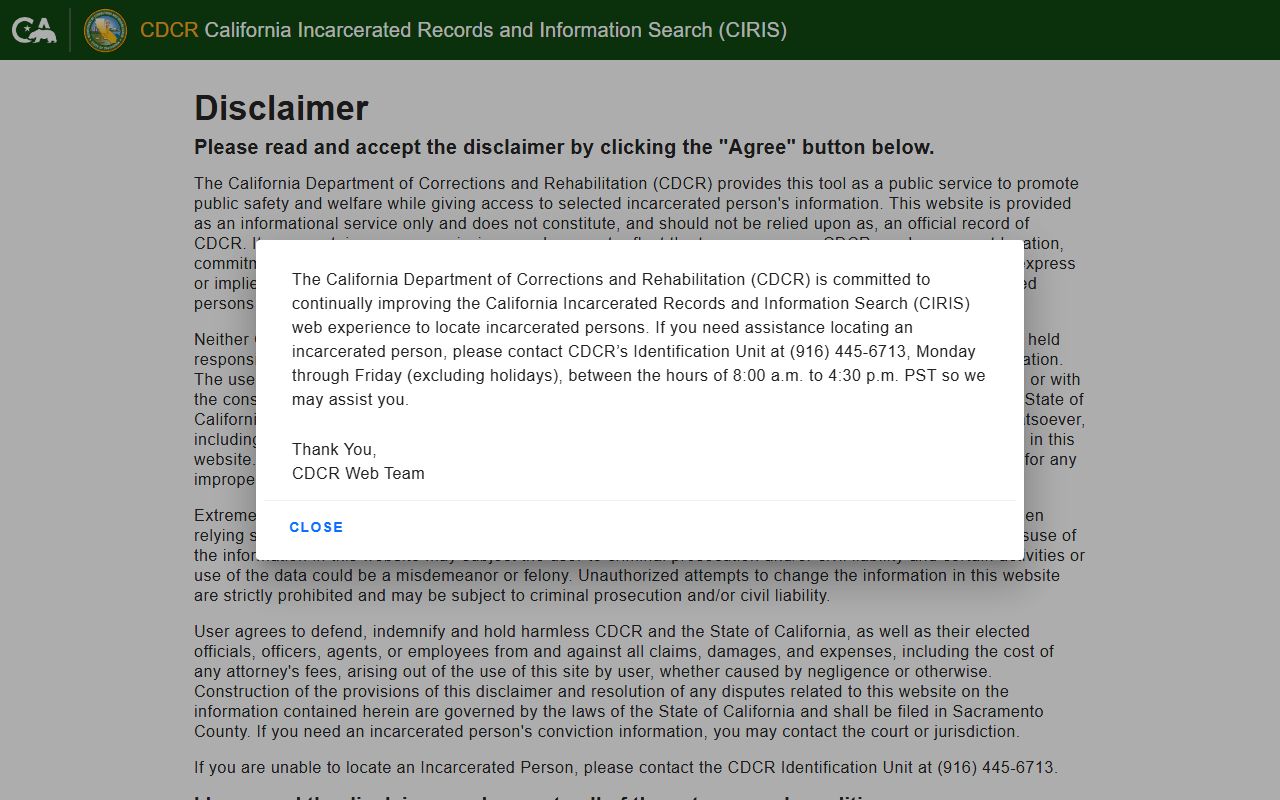 The page asks for either a CDCR number or a last name, with a first name as a second narrowing field.
| Field Label | Type | Required | Notes |
|---|---|---|---|
| CDCR Number | Text | No | Best exact match when known; format is letter plus digits. |
| Last Name | Text | Yes if no number | Required when no CDCR number is used. |
| First Name | Text | No | Narrows results for common last names. |
| Search | Button | N/A | Runs the public CIRIS query. |
A CIRIS profile typically shows the inmate's CDCR number, current housing, admission date, controlling offense, county of commitment, and a release status block. For people sent up from San Mateo County, the "County of Commitment" should read San Mateo. If the person has been paroled or discharged, the release date and supervising parole region appear next to the status. CIRIS does not show full case files. For the underlying judgment, go back to San Mateo County court records or pull the file from the Hall of Justice.
Federal inmates are tracked by the Federal Bureau of Prisons at bop.gov/inmateloc. The U.S. Department of Justice says BOP's locator lists federal inmates held from 1982 to the present. The DOJ Locate a Prison Inmate page routes the public to both BOP and the state and territorial systems. Use BOP if the San Mateo case ended in federal court, such as a U.S. District Court for the Northern District of California sentence served in a federal facility.
| Field Label | Type | Required | Notes |
|---|---|---|---|
| Find by Number | Tab | No | Switches to Register, DCDC, FBI, or INS number search. |
| Number | Text | Yes for number search | Exact federal identifier. |
| Last Name | Text | Yes for name search | Required when no number is used. |
| First Name | Text | No | Narrows common last names. |
| Middle Name | Text | No | Helps with shared first/last name pairs. |
| Race | Dropdown | No | Standard BOP race options. |
| Age | Number | No | Filter by age. |
| Sex | Dropdown | No | Male or Female. |
| Search | Button | N/A | Runs the BOP query. |
A BOP profile lists the register number, the age and race, the current facility, and the release date or "Released" status. If a federal inmate has been out for more than a few years, the record may show "Not in BOP custody" without a release date. For deeper federal case files, search PACER and the U.S. District Court docket. Local San Mateo County state prosecutions stay with CDCR, not BOP, so try CIRIS first if the case was state court.
Verifying Release in Person or By Phone
Online tools are good for a fast check, but they are not always current. The most trusted source for a same-day San Mateo County release is a live call to the Sheriff's Office. The 24-hour inmate info line at Maguire Correctional Facility is (650) 363-4000, extension 6070. The Sheriff's main line is (650) 363-4911. Staff can confirm whether a person is still in custody, has been bailed out, or has been moved to court for a hearing. They will ask for the full name and correct date of birth before sharing any custody status. They cannot give legal advice or share medical, mental health, or housing pod info on the phone.
In-person checks are possible at the Sheriff's headquarters at 400 County Center in Redwood City. Maguire Correctional Facility sits at 300 Bradford Street, just a block from the courthouse. Maple Street Correctional Center is at 1300 Maple Street, also in Redwood City. Lobby staff can confirm whether a person is on the current roster, but they will not let the public into the housing units. If a verified release date is needed for a legal filing, a court order, or a victim safety plan, the District Attorney's Victim Services unit can help walk a victim through the right office to call.
Note: Custody status from a phone call is point-in-time, not a sealed legal record. For a certified custody history, file a request with Records Management at the Hall of Justice.
The California Sex Offender Registry
The California Megan's Law site is the public-facing registry for sex offenders. The California Department of Justice runs it under Penal Code section 290.46. The home page is meganslaw.ca.gov. Local police update the records daily. Not every registrant is posted on the public site. Some show a full home address. Some show only the ZIP code. Some are excluded from the public view by state law. The CA.gov service page calls the data the most current source for registered offender info in the state.
A screenshot of the Megan's Law search portal from meganslaw.ca.gov appears here. 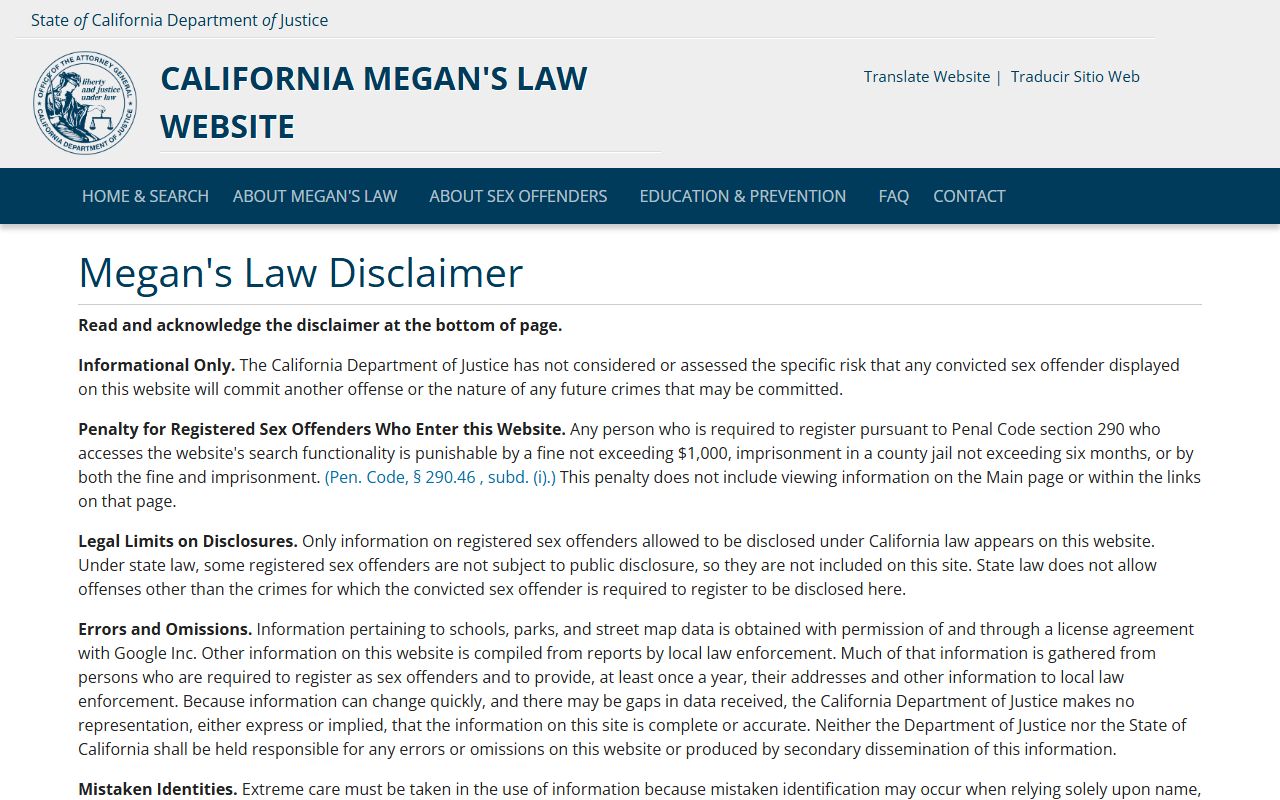 Users must click an acknowledgement before reaching the search form.
| Field Label | Type | Required | Notes |
|---|---|---|---|
| Name Search | Text | No | Search by offender name. |
| City or ZIP | Text | No | Narrows to a town, such as Redwood City or San Mateo. |
| County / Map Search | Map filter | No | Browse by San Mateo County map area. |
| Disclaimer Acknowledgement | Checkbox | Yes | Users must accept legal terms before searching. |
| Search / Continue | Button | N/A | Runs the search after the user accepts. |
A typical Megan's Law profile shows the registrant's name, year of birth, photo, physical description, list of qualifying offenses, registration status, and either a full address or a ZIP-level marker. State law makes it a crime to use the registry data to harass or threaten any registrant. The state FAQ at meganslaw.ca.gov/FAQ spells out which uses are allowed and which are barred. For a deeper criminal history check on the same person, run a name search through San Mateo County criminal records.
Parole and Probation Information
People released from state prison often come out under parole supervision. The California Board of Parole Hearings sets parole grants for indeterminate-sentence cases and runs revocation hearings. Day-to-day supervision is handled by CDCR Parole Operations. People released from county jail after a felony are often placed on Post-Release Community Supervision, or PRCS, which is run by the San Mateo County Probation Department, not the state. PRCS rules came in with 2011 realignment. The county's Community Corrections Partnership coordinates this planning. The current roster includes Sheriff Kenneth Binder, Chief Probation Officer John T. Keene, and District Attorney Steve Wagstaffe.
California Board of Parole Hearings
P.O. Box 4036
Sacramento, CA 95812
(916) 445-4072
San Mateo County Probation Department
222 Paul Scannell Drive
San Mateo, CA 94402
(650) 312-8816
To report a suspected parole violation, call CDCR Parole Operations or the local parole agent on file. To report a probation violation, call the San Mateo County Probation Department. A new arrest while on PRCS or parole can lead to a "flash" custody hold of up to ten days. Longer holds need a revocation hearing. Victims have the right under California's Marsy's Law (Article I, Section 28 of the state constitution) to be told before a parole hearing and to speak at the hearing. The Board of Parole Hearings hears these statements and includes them in the record.
Reentry Resources in San Mateo County
Reentry support in the county runs through a mix of nonprofits, public agencies, and faith-based groups. The lead local nonprofit is Service League of San Mateo County, which has worked with inmates and their families for 50 years. Service League runs in-custody programs at Maguire and Maple Street, including Hope Inside for Women and Men, parenting classes, and domestic violence programs. After release, the same group helps with reentry planning, family reunification, and referrals to housing, jobs, and treatment. The county Human Services Agency handles benefits, ID replacement, and CalFresh applications for people coming out of custody.
- Service League of San Mateo County: family and reentry support, in-custody and post-release.
- San Mateo County Probation Department: PRCS supervision and case planning.
- Bay Area Legal Aid: free civil legal help for low-income clients, including housing and family law.
- Legal Aid Society of San Mateo County: civil legal advice, pro bono immigration help for VAWA, U visas, and DACA.
- San Mateo County Community Corrections Partnership: countywide reentry and recidivism planning.
Service League of San Mateo County
727 Middlefield Road
Redwood City, CA 94063
(650) 364-4664
Bay Area Legal Aid, San Mateo Office
1048 El Camino Real, Suite A
Redwood City, CA 94063
(650) 358-0745
For a wider list of legal aid providers, the county legal-assistance page at smcgov.org lists Community Legal Services of East Palo Alto, La Raza Centro Legal, Project Sentinel, Stanford Community Law Clinic, and CORA for intimate-partner abuse support. CDCR also publishes a parolee resource guide that lists state-level reentry contacts, drug and alcohol treatment, mental health care, and transitional housing options across California. Note: Some halfway houses and transitional housing programs near the county were not captured in the source set, so the best step is to call Service League or the county Probation reentry desk for a current bed list.
Civil Rights Restoration After Release
California restores most civil rights at the moment a person is released from state or federal prison. Voting rights are the clearest case. Under Article II, section 4 of the California Constitution, and the 2020 amendment from Proposition 17, a person with a felony conviction can vote as soon as they are no longer in state or federal prison. People on parole, probation, PRCS, mandatory supervision, or county jail without a state prison commitment can vote. The Secretary of State page gives plain-language guidance and a voter registration link. Anyone unsure about their status should re-register at the local Elections Office in Redwood City after release.
Other rights are split. The right to serve on a state jury comes back once the felony sentence and parole are complete, under California Code of Civil Procedure section 203. Federal jury service has separate rules. The right to hold most state and local public office returns at the end of parole. The right to a state professional license, such as a contractor or nursing license, is reviewed case by case by the relevant board. Many boards run their own moral-character review and may consider the offense, the time since release, and any treatment or training records.
Firearm rights are far stricter. Under California Penal Code section 29800, a person convicted of a felony, or of certain misdemeanors, cannot own or possess any firearm in the state, often for life. The federal ban under 18 U.S.C. section 922(g) applies on top of state law. A pardon from the Governor or a certificate of rehabilitation may, in some narrow cases, restore the right, but most felons stay barred. Penal Code section 29805 also bars firearm possession for ten years after release on a list of named misdemeanors, including some domestic violence offenses.
Employment rights are protected to a point. California's Fair Chance Act bars most employers with five or more workers from asking about a conviction history before a conditional job offer. Many county and state job postings now follow "ban the box" rules. People can also seek to expunge or seal an old record under Penal Code section 1203.4 once probation is complete. A clean record helps with housing, licensing, and travel. For active warrants that could re-open custody, check San Mateo County warrant records before applying for a new job.